A book with pages fanned out sitting on a dark wooden table, set against a white background.

The Reading Experience

Daniel Green’s Blog and Website

  • Just Weird

    Guillermo Stitch is not the sort of writer who is going to get a lot of mainstream press coverage–the very title of his novel Lake of Urine (Sagging Meniscus Press) seems an immediate thumb to the nose where the mainstream is concerned–but such discussions of his work that can be found (mostly on blogs) use such terms as "bizarro," "new weird," and "absurdist" to characterize his fiction. It is easy enough to see why such terms would suggest themselves as appropriate to a novel like Lake of Urine, but while they might apply up to a point, this novel finally doesn't very comfortably fit into any of these categories.

    "Weird" and "bizarre" would each certainly apply to Lake of Urine as simply a general description of the novel's setting and various plot turns (although it can't really be said to have a straightforward plot), yet to the extent each is also more specifically identified with the kind of fiction that such adjectives have come to designate–"bizarro fiction," "the new weird"–the novel falls short of (or exceeds) the definitions given to these modes. While Lake of Urine has its disgusting moments–particularly in regard to the lake in question–it really lacks the full punkish grotesquerie associated with bizarro fiction, and its weirdness doesn't quite take it into the realm of science fiction but is just, well, weird (often rather amiably so).

    "Absurdist" doesn't quite capture the quality of the novel's humor, either. Historically speaking, an absurdist novel distorts reality in order to unsettle our notions of the "reality" of the real, or even to sharpen our perception of the real. The comedy in Lake of Urine, however, which follows on directly from its weirdness, serves Stitch in his effort at what is called world-building, even if it is an out of phase and peculiar world. Indeed, this seems to be the primary aesthetic ambition of the novel: to get us to accept its peculiar world as itself "real," at least as far as language and the tools of fiction can work to create this illusion.

    As if to underscore the urgency of this task, Lake of Urine offers numerous passages like this, especially at the beginning of chapters:

    Two pairs of heavy brocade curtains emit two razor-sharp slits of hard light into the cool, quiet gloom. One of these lines dissects the plum and bamboo motif of the upholstery on a cabriole sofa that sits in the middle of the room–laser-like as it cuts across the floorboards and splits the oriental design from floor to high, curved back.

    A reading table is tucked behind the sofa and on it stands a lamp. From the lamp, a gas tube winds upward like a charmed cobra to a ceiling fixture overhead. . . .

    The descriptions of the particulars of this world are, as here, almost minutely exact ("the plum and bamboo motif"), not unlike what we might expect to find in a straightforwardly realist novel. In fact, one could say that this is a realist novel, except that the writer's realism presumes a world in which a man wishes to measure the depth of a lake so attaches first a dog and then a woman to the end of his very long rope and plunges them to the bottom (neither return), another woman (the dead one's sister) escapes her home town to the city and almost immediately becomes the CEO of a very large corporation (admittedly she seems at least as competent and well-informed as the other members of the company's board), and, at the novel's conclusion, the dead woman (her name is Urine, hence the novel's title) is herself resurrected from the lake as something like a zombie. The novel's task is to convince us this world makes its own kind of sense, not to suggest that our own reality lacks it.

    There are elements of satire in Lake of Urine, but it tends to be of the rather mild and somewhat obvious sort, as in the scenes depicting Norambole (the surviving sister) interacting with her colleagues in the boardroom, an amusing enough send-up of the shallowness and cupidity of corporate values but really more just a part of the comic eccentricity of the characters' behavior in the novel than biting satire of the world outside it. This eccentricity almost necessarily makes most of the characters in the novel two-dimensional, but this does not really affect our ability to accept both them and their world as provisionally convincing fictional creations.

    Perhaps the least caricatured character in the book is Emma Wakeling, mother of Urine and Norambole. About half of the novel is in fact narrated by Emma, as she tells, in reverse chronological order, the stories of her eight marriages. (Urine and Norambole were the product of the first.) These chapters are enjoyably outrageous, Emma's pride in being a master at masturbating the men in her life ("He would squeal and cry like a girl while I did it") providing especially hilarious moments. Her manual dexterity aside, Emma is not exactly a man-pleaser; she uses her skills to control them, although this does not prevent her from making some pretty bad choices in husbands. We are also offered scenes from Emma's childhood, which among other things, gives the novel some historical grounding, enhancing the overall exercise in world-building.

    Lake of Urine as a whole is enjoyable. Its "bizarre" elements–including the potentially unsavory ones–do not make it a less agreeable work but help it rise above whimsy or "quirk." But, in succeeding at building its off-kilter world, paradoxically by using the strategies of realism, does this novel also enhance our appreciation of the ways in which the evocation of the irreal extends the aesthetic horizon of the novel? Should we be content with the world that is built, or should the way of building hold its own interest, so that such worlds do not come prefabricated? Do these things matter? Perhaps not, not always. Lake of Urine is unlike most other novels, which makes it admirable enough.

    LOU

  • The Absolute Horizon

    "Why," asks James Draney at the beginning of his review of Fredric Jameson's latest book, Allegory and Ideology, "does Fredric Jameson’s interpretive method — his insistence that the political interpretation of texts constitutes the 'absolute horizon' of all meaning — still call for defense in today's academic scene?" I'm not sure it does require defense in the current "academic scene": It seems to me that Jameson's notion that political ideology "subsumes everything else in culture" has pretty much won the day. While a few academics periodically question the totalizing influence of this orientation to literary study (everything is politics), those challenges are unlikely to remove it from its position as the authoritative assumption of academic criticism any time soon. (It is itself the pervasive "ideology" among literary scholars against which no effective resistance can really be made.)

    However, for those of us who are not obligated to defer to this critical doctrine (no tenure decision looms ahead), the answer to Draney's question actually seems pretty simple: the idea that there is no escape from the conceptual shackles imposed by "late capitalism," no alternative in our approach to reading works of literature to the exactions of "ideology critique," takes all the gratification out of reading, converts it into a dreary exercise in rhetorical self-congratulation for seeing through it all. If this is all we are to get from our engagement with imaginative literature, why bother? I already know what I'm going to find, so spending time with a literary work of any complexity or inventiveness seems pretty stupid.

    Many of us, of course, think that the complexity and inventiveness are themselves the payoff, valuable for their own sake. According to Draney, though, to believe this is to succumb to the foolishness that that "there are areas of life and culture that somehow fall outside politics and ideology," something we are not to do with "a straight face." 

    But it is possible to find this sort of gratification in reading literature, nevertheless. To do so, we don't have to believe "there is such a thing as an unmediated relationship to art, culture, Being." We can assume that of course no one can encounter a literary text in a state of radical innocence, freed of all previous exposure to the cultural presuppositions our life in the world in which we have been thrown has pressed upon us. How could we be? Why would we want to be? It is possible to find the act of reading works of the literary imagination to be itself an act of resisting the control of all ideologies, even if finally it can never be quite complete.


  • At the Bookseller, Adam Blades, a "lecturer in Publishing," attempts to defend "celebrity tastemakers" (those with "book clubs") by making this claim about actual literary critics:

    On the contrary, literary critics have rarely been objective. From Edgar Allen [sic] Poe to Elizabeth Hardwick, all promote their own approach to book criticism, injecting biases and agendas into their work.

    On the face of it, these statements are conceptually incoherent. Of course literary critics are not objective, since criticism unavoidably involves interpretation and evaluation, and these are inherently subjective processes. Even that part of criticism requiring description is ultimately a subjective kind of description–this is the way the text works as I experienced it. And of course critics promote their own approach to the act of criticism since "approaches" to criticism are all we have. (Good critics are well aware of this, and do not  pretend their own approach is "objectively" the most appropriate.) In literary criticism, "biases and agendas" are just other words for "critical judgment."

    Blades invokes "objectivity" in order to muster the usual attack on expertise or authority in literary criticism–all judgment is subjective, so no one's perspective can be valued above that of anyone else. It's all "mere" opinion. But not all critical opinions are "mere." Some are reached through sustained reflection and achieved through genuine insight. They can be defended because they are anchored in a  reading of the particulars of the work in question that is applied to a consistent overall explication intended to persuade other readers of its credibility. In other words, the critic's subjectivity is indistinguishable from the skill with which his/her "own approach" is exercised.

    Such skill is grounded in an ability (perhaps a willingness) to pay careful attention to the "particulars"–the formal and stylistic strategies the work enlists to achieve its effects–and, ideally, a sufficient familiarity with the relevant literary history in which a work of prose or poetry is inevitably situated. The latter is usually the attribute of the professional literary critic that most induces populist resentment: isn't this sort of knowledge just an exercise in pedantry, an opportunity for the elitist critic to insinuate the superiority of his own impeccable taste? While a version of this criticism remains implicit in this writer's allusion to "biases and agendas," Blades instead suggests it is finally only the "flowery prose" to which such a critic resorts that separates the self-proclaimed literary critic from the celebrity book enthusiast.

    While it may be true that too many reviewers substitute colorful phrasemaking for critical insight (although sometimes the phrasemaking succinctly embodies the insight, as in, say, the critical writing of William Gass), in my experience as a reader of reviews, the more frequent stylistic trespass is the constant invocation of the empty superlative (stunning! brilliantly original! glorious!), while the most common manifestation of an "agenda" usually involves not the promotion of a preferred critical method but the elevation of the reviewer through tedious reflections on the reviewer's own personal predilections and life circumstances.

    Blades also cites a Harvard Business School study that, he says, found that professional reviewers are "less favourable to first-time authors, and rat[e] higher books that have already received media attention." It would appear that critics are harder on debuts than Amazon reviewers, while they are also more favorable to books that other critics have praised. The bandwagon effect is indeed a noticeable phenomenon in current literary culture, and it seems to suggest that whatever standards critics manage to sustain in reviewing debut authors strangely dissipate when considering the latest from established writers. If professional literary criticism does have a credibility problem, it is highlighted here, in this herd mentality and deference to the prerogatives of reputation–a cultivation of celebrity in its own way.

  • In "Book Blogs as Tastemakers," an article by Beth Driscoll published in the Australian academic journal Participations: Journal of Audience and Reception Studies, the author discusses two "networks" of literary blogs, Romance fiction blogs and what she calls "highbrow literary blogs," to determine their influence "as shared expressions of readers’aesthetic conduct." One of the three highbrow blogs Driscoll examines is The Reading Experience.

    In her Abstract, Driscoll maintains that "Analysis of book blogs shows that while new media does enable mass participation of readers in book culture, this participation can be stratified into taste-based groups, which are themselves further stratified by a hierarchy in which bloggers accumulate a specific kind of ‘readerly capital’ evident in their influence on other readers." The Reading Experience, according to this analysis, invites readers to participate in "highbrow" book culture and itself occupies the place in the literary hierarchy where highbrow tastes (difficult books, often by obscure authors) are expressed and reinforced. (The other two blogs occupying this place that Driscoll considers are Steve Mitchelmore's This Space and Veronica Scott Esposito's Conversational Reading.) "Highbrow literary blogs complicate the distinction between amateur and professional literary criticism," Driscoll writes, "by offering long-form, highly intellectualised writing about literature."

    Although Driscoll really doesn't make many value judgments about this "highly intellectualised writing," she does at one point conclude that it "complicates a straightforward view of the internet as democratising, and suggests that the hierarchies of literary culture persist and are, in some form, reproduced online." As she more or less admits, however, the room at the putative top of this particular hierarchy is exceedingly small. Driscoll identifies Esposito, Mitchelmore, and me as "influencers" in this sphere, but while I cannot speak for the other two, in my case I have to say that my "influence" on most days is, from my own perspective, all but impossible to detect.

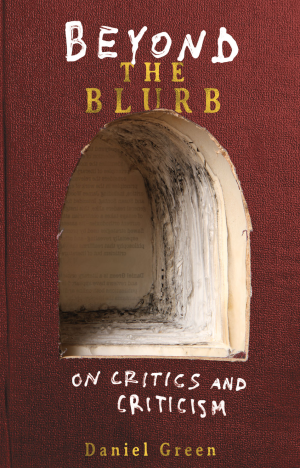
    Driscoll quotes a comment made by a reader of an interview I gave a couple of years ago (upon the publication of Beyond the Blurb):

    I admit, I am intimidated by The Reading Experience. I have clicked over there, and quickly clicked away, because I don’t see any footholds… all seems to be authors and books I’ve never heard of.

    I myself admit that this comment dismays me. Although it has certainly been one of my goals to bring attention to "authors and books [you've] never heard of"–because the author or book in question has been unjustly neglected in a literary marketplace that prioritizes the already done and the already known–I am certainly disappointed to hear that some readers have found no "footholds" in my approach. If to find a foothold means to come upon the usual books discussed on the popular sites and in mainstream book reviews, then generally speaking new readers of this blog have no doubt often lost their footing. But if I have been unable to make my commentary on unfamiliar–indeed, perhaps "difficult"–works or on more "technical" issues of literary criticism accessible to general readers, I have not succeeded in one of my aims in starting the blog. I indeed hoped to "complicate the distinction between amateur and professional literary criticism"–more precisely the distinction between general-interest and academic criticism–but I also wanted to make such a hybrid practice intelligible to all good-faith readers, certainly not intimidating.

    Driscoll maintains that, in This Space and The Reading Experience at least (Conversational Reading, she says, has a different tone, the writing "clearer, more straightforwardly structured" and thus leaning "more towards the mode of the middlebrow), the writing steadfastly "refuses to be accessible." Again speaking just for myself, this is not my intention at all. Since I believe an important function of criticism is accuracy of description, I would be subverting my own purposes if I deliberately used obfuscating language or fixated on arcane issues. In order to give an accurate description of a literary work–more specifically, of my attentive experience of the work–it is, however, sometimes necessary to focus on some qualities of a literary work in a way that goes beyond the customary sorts of judgments and generalizations that often pass for literary criticism, to use locutions that are more precise if not regularly employed in more casual discussions of books. Perhaps what Steve Mitchelmore and I have in common is that we both believe a literary work requires the reader's commitment to the work's own autonomous reality, making the critic (as first of all a reader) a kind of witness to the imaginatively authentic qualities of this invoked reality, to adequately describe which calls for some acuity of thinking and exactitude of language.

    I have to agree with Driscoll that of the three of us she includes in her analysis, it is Steve Mitchelmore who has most steadfastly maintained "the autonomy of blogging as an intellectual practice." Although he began at one point to stretch out beyond his blog to other outlets (including TLS) for his critical writing, for a number of years now he has mainly confined himself to This Space, the freedom of which he values over the greater exposure he might get from also writing for other publications. There is surely something admirable in Mitchelmore's dedication to the writing over the wider recognition his forays into print publication might have brought. I myself decided to seek out opportunities as a book reviewer beyond The Reading Experience, not in search of external validation or prestige but to possibly reach a wider audience of readers. (The most prestigious publications have yet to come calling.) I have tried to maintain this blog along the way, but I admit it has too often been neglected in favor of these other writing projects. On balance, I've probably indeed reached more readers than if I'd attended to the blog alone more diligently–although I intend to continue writing on the blog, even if it is a different kind of writing (not as loose and informal) than would have been found here in the early days of litblogging, and at a time when most of the prominent blogs of that time have ceased to exist or have remained dormant for many years now.

    If I am an "influencer" in online criticism, as Driscoll has it, it certainly isn't reflected in my blog stats, and most of the reviews and essays I have written elsewhere receive a few generous retweets but generally disappear from view rather quickly. (I have, however, reworked some of these into the ebook volumes I have put together.) I don't begrudge this situation, because ultimately I agree with what I take to be Mitchelmore's position, which is that the satisfaction of writing is in the writing itself and its service to literature, not in ancillary recognition. I am grateful for whatever readers I have–and most of them are themselves very intelligent people who simply have an interest in literature, not in "high culture" as a "commodity"–but I view this blog and my other writing not as an exception to the "democratising" of online literary culture but its very embodiment: a failed academic started a blog and succeeded enough that a successful academic thinks he could be a "tastemaker."

    Addendum–Driscoll mentions a couple of times in the article that I have a Patreon account that helps to "crowdfund" my writing activities. Although I did briefly have a Patreon account a while back, the crowd funding me was in fact barely a cluster, and that account is now inactive. Except for the small amounts of money I have made as a reviewer and freelance critic, I sustain The Reading Experience on fortitude alone.

  • More on Purdy

    Some passages in my original draft of the essay on James Purdy's poetry recently published by the Poetry Foundation had to be excised for reasons of space and relevance. But I still rather like much of what I said in them, so I am reprinting them here rather than discard them entirely.

    On In a Shallow Grave and Narrow Rooms:

    Most of the important tendencies in Purdy's fiction were worked out in the novels of the first decade of Purdy’s career, but two of the novels published in the 1970s, In a Shallow Grave (1976) and Narrow Rooms (1978), realize them in particularly powerful ways. Both set in rural America, In a Shallow Grave enacts Purdy’s predominant themes through the form of what might be called a pastoral romance, while Narrow Rooms might be called a pastoral tragedy (although more in the mode of Jacobean revenge tragedies than the Shakespearean sort). Garnet Montrose, the protagonist and narrator of In a Shallow Grave, is both one of Purdy’s innocents, in effect made so through the loneliness imposed by a disfiguring, war-related injury, and a character who must come to terms with himself—although in this case the resistance to self-knowledge comes less from willful blindness on Garnet’s part than from the oppressive situation in which he has been forced to live. His isolation is overcome when he receives the sincerely given friendship of Quint, an African-American boy, and falls in love (not sexually consummated) with Daventry, a young drifter. Ultimately Garnet obtains a kind of redemption through a remarkable act of self-sacrifice performed by Daventry (involving a ceremony of ritual bloodletting and a subsequent violent hurricane). It is perhaps Purdy’s most affirmative book, although it is in no way sentimental, despite the temptation offered by Garnet’s rather pathetic circumstances; its depiction of human weakness and the deforming effects of American social arrangements is as uncompromising as any of Purdy’s other, more unremittingly bleak narratives.

    Narrow Rooms, the immediate successor to In a Shallow Grave, would have to be called one of Purdy’s bleakest. It is also the novel that most directly addresses homosexuality as its subject, or at least uses explicitly identified homosexual characters to tell its story. Finally the novel portrays the characters, in their inability to fully accept their own natural impulses and desires (especially one of the characters, known as “the Renderer,” who takes his self-hatred to murderous extremes), much as they are portrayed in Purdy’s other novels, where homosexuality per se is either mostly unspoken or merely suggested. The violence and degradation accompanying this story of a group of homosexual men in West Virginia did not exactly endear Purdy to a gay community otherwise eager to champion gay-themed novels and self-identified gay writers. Purdy always insisted that he was not interested in being regarded as a “gay writer,” and that indeed his subject was not homosexual desire in itself, or the myriad consequences of asserting a homosexual identity, but, as he shows with particular power in Narrow Rooms, the palpable effects of the seemingly intractable human propensity for self-destruction and accompanying ability to live in illusion and profound alienation from our most authentic selves.

     On Purdy as dramatist:

    Although James Purdy throughout his career was regarded primarily as a writer of fiction, he also worked in the other genres, poetry and drama. Both of these activities enabled Purdy to interact more widely with the theatrical community in New York (where he lived for the last 50 years of his life), as well as classical musicians and composers, when two of the latter set a number of Purdy’s poems to music. In fact Purdy wrote more than twenty plays (ten of them full-length), although not all of them were performed. It is not surprising that Purdy would be drawn to writing plays, since in his novels and stories he uses a scenic method that is predominantly structured though extended passages of dialogue. Indeed, one of the singular features of Purdy’s fiction is his treatment of American speech, which blends idiomatic talk and vernacular speech patterns with a more formal sensibility, as if the available forms of expression are struggling to transcend their own diminished powers of articulation. The speech of Purdy’s characters may or may not be “realistic,” but it is remarkably consistent across all of his work and helps create the uniquely off-center tone of his fiction.

    On the "poetry" of Purdy's fiction:

    If it could be said that Purdy’s fiction has a kind of “poetic” effect,” perhaps that effect emerges not from overtly poetic turns of phrase or a conspicuously “lyrical” prose style—Purdy seldom indulges in flourishes of “fine writing”—but in this distinctive tonal or atmospheric impression Purdy’s writing so tangibly makes on the reader, both during the reading experience itself and when afterwards contemplating its cumulative aesthetic character. While Purdy’s novels all tell stories, it would be reductive to think of them purely as narratives, even of the “gothic” variety critics sometimes identify as Purdy’s chosen narrative mode. Poe famously identified the goal of a short story as producing a “unity of effect,” an achieved integration of structure, mood, or milieu that forges the aesthetic whole that makes a work of fiction more than the mere summation of its parts. Purdy’s fiction, stories and novels alike, is best appreciated for its compelling unity of character, event, setting, and perspective into singular works of verbal art.

  • Sinking or Swimming

    In an interview with Lit Hub (for its "Secrets of the Book Critics" series), Madeleine Schwartz asserts that 

    Broadly speaking, the internet has been terrible for book criticism and book critics. Book reviews have been shuttered and magazines have folded. It’s nearly impossible to make a living writing criticism, which in turn means that authors with books out can only sink or swim. The excitement about new online venues has been heartening, but unless the economics of reviewing changes, the profession only has about five years to live. . . .

    Perhaps Ms. Schwartz is predominantly thinking of the low, or absent, payment book reviewers can expect when she claims "the internet has been terrible for book criticism and book critics," although she would then be referring mostly to the latter. However, that entirely legitimate concern does not at all justify a claim that the internet has been damaging to criticism, considering either its quality or its visibility. Literary blogs and online book review sites, as well as some online literary magazines, have over the past 15 years greatly supplemented the serious discussion of new books that previously took place solely in print newspapers and magazines. (These sites have also made possible a complementary discussion of not-so-new books that did not much exist at all in the newspapers and magazines.) They have also enhanced the coverage of translated books, which still get minimal coverage in print. There are in addition many more longer-form reviews and extended critical essays than were ever allowed to appear in other than the most resolutely "intellectual" of print magazines. Anyone who thinks the shuttering of newspaper book reviews has diminished the availability of informed criticism devoted to the purposeful consideration of books and literature just doesn't know where to look.

    It is almost certainly true that "It’s nearly impossible to make a living writing criticism," and equally true that some of even the best of the online book review publications don't pay their reviewers, a regrettable state of affairs. Further, it is arguably the case that the internet was terrible for writers whose primary review outlets were the newspapers and magazines that scaled back if not eliminated books and arts coverage–as well as other "frills"–because their readership in general declined in competition with online media. But the general nostalgia expressed by critics like Schwartz for the golden days when critics could make a living from writing print-based reviews and literary journalism seems to me misplaced, if not an outright fantasy. I am unaware of many general-interest book reviewers and critics–even the iconic ones, from Edmund Wilson or Elizabeth Hardwick in a much older generation of critics to John Leonard or Helen Vendler in a more recent one–who were able to subsist on reviewing alone. Most had teaching jobs or worked in editorial or publishing positions. Perhaps some could use book reviewing to supplement income from writing books.

    The sum of money paid for newspaper and periodical reviews, however, surely could not alone support a professional career in criticism. Even today, it is hard to imagine that the few hundred dollars a book review might provide could be sustained consistently enough to actually contribute a great deal to a "living" as a critic (an actual critic, and not a lifestyle journalist or ersatz book publicist). To say the least, I am pleased when I receive payment for reviews and criticism I write. But I never thought that writing literary criticism was a lucrative career move, and I don't believe that criticism will die in five years. Some things are worthwhile in and of themselves and don't require affirmation  through their market exchange value.

  • Still Inside That Book

    In her response to listening to a reading given by John Dos Passos at the 92nd Street Y in 1965, Lydia Davis reflects on her own reading of Dos Passos as a formative experience:

    The Dos Passos book, whichever one it was, was also the first, or early, in the long list of books that I never finished reading. A book whose story captivated me, I would finish. A book which, on the other hand, excited or inspired me by the way it was written, I usually would not. I would read just enough to absorb the nature of the book, understand the approach, become excited by the texture of the writing, and then I would put the book aside. I don’T think this was mere laziness, or distraction. There is a real difference between a book unfinished and a book read to the end. A book read to the end gives one a clear idea of the whole of the book, the overall structure and full content, and that is one sense of a book, a more complete sense, you might say. But a book unfinished allows you to feel you are forever afterward still inside that book, that you are part of it, live in it, continue the experience of it, and that its further continuation and conclusion remain forever mysterious.

    I cannot say I have deliberately left many good books–books providing a gratifying reading experience–unfinished for the reasons Davis describes here. However, those reasons strike me as entirely cogent, especially when contrasted with finishing books and getting "a clear idea of the whole of the book" if "clarity" is understood not as knowing "what happened" in the end but as achieving something like interpretive closure, fully grasping what a literary work is supposed to "mean." A book that leaves the impression of such clarity is likely just a book that won't be worth rereading–its value as literature has been used up.

    Obviously this indicates that I don't regard the "literary" as residing in what is left over after reading–call it "meaning" or "lesson" or "wisdom" or what have you–but as something that makes itself present during the reading experience itself. I would feel that I am not fully appreciating the work as a literary achievement if I voluntarily stopped reading it–except when I can already judge it a very bad book. But I must confess that in the time after I have finished reading a poem, story, or novel I often (actually almost always) do allow the particulars, beyond, say, the major characters in a novel, the broad contours of situation and story (although not really the plot details), as well as the general formal and stylistic character, to fade from memory. This is not the consequence of a porous memory but the recognition that no one reading of a literary work is authoritative, or even stable, and that a subsequent reading would not be mere repetition of the initial experience. It would be neither inferior nor superior to that first reading but a new opportunity for the "literary" to be discovered.

    I have sometimes upon rereading had not simply my judgment of a particular book altered but my fundamental orientation to it transformed. It's not just that my view of a character changes or I understand particular episodes more fully or I find the writer's style more, or less, impressive: the book seems so dissimilar from what my memory retains of it that it could be called a wholly different book. (I had this experience rereading James Purdy's Malcolm–which I have since reread again–after reading it for the first time in college, when I was unable to "identify" with its protagonist; in my second reading it seemed to me something like a masterpiece in the way it made identification with the protagonist beside the point, a kind of MacGuffin, to use Hitchcock's term.) More often I just "see" things in a rereading I didn't see the first time, enough so that it is as if I actually haven't read the book before and must assess its literary qualities anew. Even then, my renewed appreciation of the work's aesthetic accomplishment must remain contingent, since a subsequent rereading might again readjust my perception of it.

    Perhaps this process resembles Davis's attempt to "continue the experience" of the book she leaves unfinished, but it in fact presumes not a single experience of a literary work but multiple separate and autonomous experiences. It is possible to say that after multiple readings of a particular book that I have learned to read it better (but not necessarily), although other factors contribute to this as well–familiarity with the writer's other work, reading more widely in general, etc. Of course, it is not possible ultimately to reread every worthy book. Still, I would maintain that the best way to achieve the state of feeling "still inside that book" is to assume the first reading will not be the last.

  • In 2002, I published in a now defunct literary magazine this lengthy review of Richard Powers's Plowing the Dark. My review of Powers's latest novel, The Overstory, appears in the new issue of The Quarterly Conversation, and in that review I make reference to this older review as counterpoint. I am here making the earlier review available for fuller context.

    Forsaking Illusions

    Richard Powers clearly signaled in his auspicious first novel, Three Farmers On Their Way to a Dance (1985), that his fiction would not conform to the then-emerging conventions of literary minimalism or participate in the full-scale return to the values of traditional realism that would characterize much literary fiction in the 1980s and 1990s. But neither would it share all of the assumptions nor necessarily employ the most ostentatious of the strategies associated with "postmodern " or "experimental" fiction of the 1960s and 1970s against which minimalism and neorealism were clearly, if quietly, a reaction. Although innovative in narrative structure, insistently self-reflexive, and often stylistically extravagant, Powers's novels nevertheless would hardly be inaccessible to readers who still expect fiction to foreground compellingly portrayed characters in­ habiting o world recognizably drown from the familiar world of ordinary experience.

    One might presume that an approach neither wholly conventional nor radically experimental, with seeming allegiances to both camps, would risk being accused of splitting too many differences and thus would not be enthusiastically received either in mainstream literary circles or among the partisans of the offbeat and innovative in contemporary writing. Yet, by the end of the 1990's, Powers was being hailed by nu­merous reviewers as worthy of the designation "best living American writer." While this kind of attention from the popular press is no doubt gratifying to Richard Powers, and certainly seems entirely appropriate to those of us who admire his work, it is difficult not to suspect that such praise arises as much from a lack of understanding–in some cases, outright misunderstanding–of Powers's fiction as from real sympathy with his aims and methods. Indeed, it would not be surprising if his very strengths as a writer eventually come to be cited by many of those now warmly applauding as a source of discontent when they find themselves explaining their otherwise perplexing loss of enthusiasm for his work. At least one reviewer of Plowing the Dark, Michael Ravitch in the New Republic, does seem confused by his perception of difference-splitting, noting on the one hand that Powers's "linear associations and neat structures are reassuring to those seeking clarification and organization" and on the other that "too often his verbal associations run amok, without any purpose except self-display."

    That Powers is an abundantly gifted stylist is undeniable—even Ravitch acknowledges that his “verbal fireworks can be delightful”—but as with other contemporary American writers who seem especially attuned to the figurative and rhetorical possibilities of language, such as John Hawkes and Stanley Elkin, style in Powers’s fiction counts for much more than the occasional ornamental flourish, nor can it be taken as merely the vehicle of poetic “insight.” For these writers, style is not something added to the work, or through which its implicit “subject” is expressed, but is itself inseparable from the work their texts literally enact and must in some fundamental way be acknowledged as the most compelling subject—certainly the most compelling for the authors—of those texts. Powers is thus a writer whose fiction is easy enough to admire as “well-written,” but such a locution doesn’t come close to describing either the ambitions animating his style or the formal effects it makes possible for the attentive reader, and in fact can just as easily be used, as we have seen, to belittle a writer otherwise judged by the inattentive reader to be too self-consciously literary for his own good.

        Gain (1998) begins in this way:

    Day had a way of shaking Lacewood awake. Slapping it lightly, like a newborn. Rubbing its wrists and reviving it. On warm mornings, you remembered: this is why we do things. Make hay, here, while the sun shines. Work, for the night is coming. Work now, for there is no work in the place where you are going.

    May made it seem as if no one in this town had ever sinned. Spring unlocked the casements. Light cured the oaks of lingering winter doubt, lifting new growth from out of nothing, leaving you free again to earn your keep. When the sun came out in Lacewood, you could live.

    Even the casual reader, of the sort most likely with any novel to be "reading for the plot," would probably find this an evocative passage, setting the scene for us (even if it will be the setting for only one strand of the novel' s twin plots) in an imaginative and energetic way and in images and phrases that signal an author able to use language with unusual skill and facility. It is indeed well-written. Perhaps the casual reader will also notice, although not necessarily in any direct way, the more subtle effects of such a passage: its insistent alliteration–"Slapping it lightly like a newborn. Rubbing its wrist s and reviving it."–its immediate equally assertive assonance–"Day had a way of shaking Lacewood awake"–its ingenious tropes and overall euphony, both of which are manifestly appropriate to the phenomenon the passage essays to represent, as these paragraphs themselves mimic for the fiction they begin the process they simultaneously describe, a coming-into-being, of a spring day in Lacewood and of the novel Gain.

    Yet this is precisely the kind of stylistic self-consciousness and hyperformalism attributed to postmodern fiction–at least with that version thought to be preoccupied with artifice and wordplay–that has gained notoriety for some American writers over the past forty years or so, and in a few cases a grudging respect if little enthusiasm, but has otherwise never led to any of these writers being recognized as one of "our" most important writers in publications not already well-known for their sympathetic consideration of this group of writers (journals such as Critique or The Review of Contemporary Fiction, for example.) Although Hawkes and Elkin, Barth, Gass, and Coover have by now garnered their share of attention from academic critics, and as a group certainly have produced the most accomplished body of work in postwar American fiction, they are not the writers most highly esteemed by the current arbiters of literary taste and reputation. And surely it will not escape them for long that as a stylist Powers belongs in their company rather than with those acceptably conventional but earnest writers usually associated with "fine writing."

    But Powers is not a stylist for style's sake alone. Indeed, he has spoken in a recent interview (1998) of his essentially utilitarian view of style: "I've tried to approach each book as an experiment in finding the style that best supports and exemplifies a particular story's themes." If Powers's prose style is more than merely pretty, it, is also never less than functional, although to read his novels profitably it is necessary also to rethink the relationship between function and form that our ways of speaking about works of fiction generally assume to obtain but that Powers puts into question as keenly as any contemporary novelist. Which is not to say a novel like Gain cannot be read with a certain degree of pleasure even while remaining unaware of its formal innovations beyond its signature intertwining of related but separate narratives, only that, in keeping with the theme these narratives mutually reinforce, a gain in the direction of accessibility entails a loss in sensitivity to the full range of effects-to all of the potential sources of meaning-made available by a writer so thoroughly attuned to these possibilities. It is not so much that in novels like Gain and Plowing the Dark (2000) Powers privileges one over the other, settling either for an unqualified aestheticism or an untroubled rhetorical transparency, but that, like the braiding strands of DNA that provide the structural figure in The Gold Bug Variations, form and function are inextricably joined, their interaction producing the basic principle, simultaneously structural and thematic, by which each novel takes its shape.

    The Gold Bug Variations (1991) makes most explicit a metaphorical linkage be­ tween the role played by the genetic code in organizing the processes of life and that played by language in organizing narrative, the latter in turn mediated in this novel by an even more explicit analogy between DNA sequencing and music. Gain is built in a perhaps even more thematically compelling way around this trope, as somewhere in the unfolding story of Clare International, a multinational chemical manufacturer, lies the innate defect responsible for the cancer affecting Laura Bodey, the protagonist of its parallel plot. The juxtaposition of the chronicle of Clare's ascendancy in the world of American business with the tale of Laura's ultimately unavailing struggle with her dis­ ease led numerous reviewers to highlight what they took to be the polemical implications of this dialectical pairing, thus reducing the novel to a rather obvious critique of capitalism run amok. But nothing in Power s's other novels suggests an interest in this kind of direct political commentary, and in fact an attentive reading of Gain could not find evidence that such crude didacticism is in any way one of its significant features. If anything, one is likely to find the history of Clare International to be related in a surprisingly dispassionate, even respectful, manner, an impression that, far from producing an easy outrage on behalf of Laura Bodey, only lends to her story a more genuine pathos. An unwitting victim of what begins as an exercise of initiative and ingenuity, she seems not a martyr to the American business ethic but an otherwise ordinary, though ultimately strong-willed, woman forced to confront the unintended consequences of such ingenuity, as Adie Klarpol will have to do in Plowing the Dark.

    The dialectical relationship that truly structures Power's fiction can be seen, in fact, as precisely the perpetual conflict between the inescapable contingencies of existence and the apparent human need to resist, if not overcome, those contingencies. Since The Gold Bug Variations at least, the embodiment in Powers's fiction of this ingrained need has generally taken the form of technology-the potential applications to be derived from scientific research in genetics, medicine (Operation Wandering Soul), artificial intelligence (Galatea 2.2). While Powers has acquired a reputation as a writer conversant with science–a characteristic uncommon enough among writers of literary fiction to partly account for the heightened attention paid to his work by reviewers–his concern seems not to be with science per se, which Powers represents as an essentially esthetic endeavor, but with the place of technology in our lives–a place, on the one hand, taken up via an entirely natural human impulse that, on the other, licenses a technology the inner logic of which might only partially encompass other distinctive values. This clash of values, at work provocatively in both Galatea 2.2 and Gain, is highlighted perhaps most emphatically in Plowing the Dark.

    If Gain reveals the unforeseen and intangible costs exacted by our long-term investment in "progress" (without suggesting we can merely renounce the idea, or that it can’t be harnessed for beneficent purposes), Plowing the Dark portrays the process of technological advancement much more directly, and as much more clearly sinister. Again a dual stranded narrative, it begins with the story of Adie Klarpol, a commercial artist prevailed upon by an old college friend to move to Seattle to work in "The Cavern," a virtual reality "immersion environment" operated by a high-tech company called TeraSys. Convinced the Cavern is a site for pure research–allowing her to indulge in a kind of free-form creativity–Adie joins the team being employed to explore the Cavern's possibilities, an effort that involves Adie in virtual recreations of Van Gogh's portrait of his room at Arles and of the Hagia Sophia cathedral in Constantinople. To her horror, Adie ultimately discovers that the technology she's helping to develop is destined to be used by the U.S. military in the creation of ever more sophisticated smart weaponry.

    The opposition between aesthetic sensibility–here shown to be possessed by almost everyone working on the Cavern project, all of whom seem to share a capacity to take delight in the sheer expressive possibilities of their chosen media–and mercantile expedience could not be more sharply drawn, and again one could easily enough sett le for the obvious, but not for that reason trivial, political interpretation of Plowing the Dark. That Powers means to raise questions relevant to politics would seem to be confirmed by the second of the novel's narrative strands, which hearkens back to the era of hostage-taking by Lebanese militants and relates the grim particulars of the capture and captivity of Taimur Martin, an American teacher in Beirut. But this story only illustrates the perils and the ultimate futility of politics, as Taimur's ordeal can in no way be justified as a necessary consequence of political struggle, even if inflicting such suffering could be shown to further an otherwise worthy political cause. Although Adie Klarpol's resignation from TeraSys after discovering the ugly truth is likely to be a fruitless political gesture, it at least confirms Adie ' s own moral integrity. Such cannot be said for the acts of Taimur Martin 's abductors, who, of course, are just as little concerned with the human lives affected by their actions as the most mercenary purveyors of lethal technology.

    What both Adie Klarpol and Taimur Martin learn about political conflict is that it is ubiquitous, potentially hazardous, and finally completely inadequate to the needs of a seriously considered, satisfying life. But this insight into the limitations of politics is by no means the only, and certainly not the most important, knowledge acquired by the twin protagonists of Plowing the Dark through the experiences the novel relates. And while it might seem to discount especially the sheer misery that is the essential quality of Taimur's time in captivity, it is nevertheless appropriate to focus on what–and how–these characters learn from their experiences, for it is the nature and provenance of knowledge itself that serves as both the novel's structuring conceit (reinforcing the underlying figurative translation of the double helix into a form of storytelling) and its overriding theme.

    TeraSys’s "Cavern" is clearly enough a version of Plato's cave, a technologically updated   representation of the potentially confounding interplay of reality and illusion, a place where, in Plato's allegory, a delineation of the boundary between what is real and what illusory is shown to be not only possible but objectively necessary if human beings are to liberate themselves from the tyranny of appearances. Adie Klarpol is thus in the position of the individual in Plato's cave who manages to free herself of the fetters restricting her attention to the shadows that pass for the real things, and to make her way out of the cave of projected phantasms to a clearer perception of the existential truth. However, where the truth for Plato lies outside ordinary human reality, for Adie Klarpol (and one presumes for Richard Powers) truth is to be sought within, through a more scrupulous understanding of what is most compellingly human about human reality. The knowledge she eventually embraces (and that in a sense embraces her in turn) is an aesthetic knowledge that the Cavern's virtual world can inspire only inadvertently, by reminding her of its source in an unconstrained openness to one's experience in the world, not in a flight from it.

    Taimur Martin unfortunately finds himself confined to a cave of his own, a bare room in which his captors keep him literally in chains, releasing him only for the most necessary of natural functions and, eventually, a minimal amount of exercise. Unencumbered by the simulated illusions Adie Klarpol is forced to dispel, Taimur nevertheless is compelled by his circumstances to review the course his life has taken, to examine his assumptions and to test the limits of his own consciousness. Significantly, the act of reading comes to have special value for Taimur. Deprived of books, Taimur tries to recreate the now-precious experience of reading:

    You reach the opening sentence, the fresh start of all things possible. Modestly boundless, it enters bowing, halfway down that first right-hand page. You lie back against your paradise wall, your pillow. You make yourself a passive instrument, a seance medium for these voices from beyond the grave. Politics has taught you how to read, how to wait motionless, without hope. To wait for some spirit that is not you to come fill you.

    This emptying out of self that Taimur now realizes is the necessary condition in which to answer the claims of literature (Taimur tries to reproduce the experience of reading Great Expectations) is the more general state he is finally able to reach, an emptying-out of distractions that is paradoxically the most profound source of self-knowledge:

    There is a truth only isolation reveals. An insight that action destroys, one scattered by the slightest worldly affair: the fact of our abandonment here, in a far corner of sketched space. This is the truth that enterprise would deny. How many years have you fought to hold at bay this hideous aloneness, only now discovering that it shelters the one fact of any value.

    To abide "without hope"–to respect the integrity of experience in its own right—and to acknowledge the limitations of "enterprise"–before human actions transcend themselves to become fantasies of total control–are imperatives both Adie Klarpol and Taimur Martin come to affirm. That these imperatives can be realized most purely, although not exclusively, in the experience of art is provocatively suggested by the lone, and very surprising, encounter between Adie and Taimur in Plowing the Dark. Before leaving the Cavern for good, Adie steps one last time into the cyberspace cathedral (attempting to recreate the original has proven to be Adie's profoundest education in e sources and the aspirations of art) and after a virtual ascent "all the way into the uppermost dome, now inscribed with its flowing surah from the Qur'an" she begins to fall back "like a startled fledgling, back into the world's snare."

    . . .The mad thing swam into focus: a man, staring up at her fall, his face an awed bitmap no artist could have animated.

    From his side, Taimur Martin has fallen into his own hallucinatory state, "soft-landed in o a measureless room . . .the dementia of four years solitary . . .where all your memorized Qur’an and Bible verses ran together jumbled."

    Then you heard it, above your head: a noise that passed all understanding. You looked up at the sound, and saw the thing that would save you. A hundred feet above, in the awful dome, an angel dropped out of the air. An angel whose face filled not with good news but with all the horror of her coming impact. A creature dropping from out of the sky, its bewilderment outstripping your own. That angel terror lay beyond decoding. It left you no choice but to live long enough to learn what it needed from you.

    If Taimur wants to know what the "angel" needs from him, it seems equally certain that she–Adie Klarpol, confronting Taimur in a kind of apotheosis of their mutual abandonment to the demands of living "without hope"–will require the kind of knowledge Taimur has so painfully obtained as well if she is to pick herself back up after her fall. Adie has come to recognize the illusory appeal of participation in "worldly affairs" (as opposed to an authentic engagement with the world), but perhaps she has not yet appreciated the "hideous aloneness" Taimur has discovered to be the only indispensable truth. That Taimur desires to bring this truth to bear on the affairs of a newly recovered world is understandable enough. In fidelity to Plato's allegory one can only question whether in the customary world neither Adie nor Taimur can ultimately avoid inhabiting very many of their fellows can adequately understand what both of them have truly learned.

    Yet Powers' s title suggests a significant revision of Plato's tale. The process of acquiring true knowledge is portrayed in the novel not as something that culminates in a flash of insight, a coming-to-see- the-light, but as a long and arduous task of "plowing the dark." Powers's version ultimately subjects what has arguably been historically the most resonant philosophical account of the nature of knowledge–which continues to provide the conceptual paradigm for most of modern science–to an implicit critique through a counter­narrative in which both the reality that human beings can only flourish in a social association with others and that they are capable individually of arriving at the profoundest kind of self -knowledge are vividly illustrated. If these twin truths are, after a fashion, inscribed in the genetic code, so too are they illuminated most brightly in the kind of narrative fiction Powers has devised to convey the experiences of Adie Klarpol and Taimur Martin. But this fiction, unlike Plato's, does not direct us to a world of aesthetic perfection outside the contingent human world; instead it leads us even more firmly back into the human world, exploring those possibilities of enhancing and clarifying experience that ought more properly to be attributed to the aesthetic. This fiction, although possessing its own sort of luminosity, ultimately shares in the labor of plowing the dark, inviting us to make our own way through the furrows created by Richard Powers's resourceful prose and probing intelligence.

  • One of the more beneficent consequences of the rise of, first, literary weblogs and then book-oriented social media has been the enhanced opportunities to "rediscover" neglected and half-forgotten writers and their underrated books. Over the past decade or so, no better example of such a collective rediscovery could be cited than the American writer John Williams and his 1965 novel, Stoner.

    I have until now put off reading this novel myself not only because it seemed to me that the praise being lavished upon it was excessive and would likely provoke a kind of resistance that would interfere with my ability to honestly assess it (and not the phenomenon that brought it to my attention), but also because from what I could determine about its subject, it might seem uncomfortably familiar. Like the titular protagonist William Stoner, I, too, was raised in rural Missouri and attended the state university in Columbia. I as well studied English, despite its obvious lack of practical relevance, especially as seen by those who had sent me to the university in the first place, and found in literature something of a life's calling and set out to be a professor myself. Like Stoner, I gathered multiple degrees at that state university and eventually spent a significant part of my subsequent life (unlike Stoner, not all) teaching there.

    In short, I assumed I would see a good deal of myself in William Stoner, no doubt suspecting (unconsciously, at least) I might find in Stoner's story a parallel to my own vexed academic career, which, too, could prove to be a distraction. I do not require that a character in a work of fiction be one with whom I am able to "identify," and perhaps in Stoner a character who in effect forces such an identification would only divert my attention from the novel itself, encouraging instead a preoccupation with personal circumstances separate from any possible relevance to the reading experience. Presumably some people believe that it is one of the purposes of a novel precisely to provoke reflection of this kind on the reader's part, but in my view a successful novel does this only accidentally, as a side effect of its realization of the writer's more purely artistic vision that otherwise avoids reducing literary art to an exercise in self-obsession.

    As it turned out, my apprehensions about reading the novel were mostly unwarranted: I was not really tempted to identify with Stoner, because William Stoner is actually not a very interesting character. Perhaps this is partly intentional. Stoner more or less stumbles into the life he winds up leading, as his initial plan (itself not very definite and largely determined by his father) to study agriculture at the university is put aside when he finds himself interested in literature after taking a required introductory course. Even thereafter, when Stoner is ostensibly pursuing his newly acquired ideals as a literary scholar, he seems peculiarly passive, accepting the opportunities the university offers him to establish a teaching career, but showing little ambition to distinguish himself, either as scholar or as teacher. After writing one book that brings him some satisfaction but little recognition, he never writes a second, and although a time comes when he perceives he is becoming more popular as a teacher, that time comes and goes quickly, the remainder of his academic career indeed appearing to confirm the narrator's assertion at the beginning of the novel that at Stoner's death "few students remembered him with any sharpness after they had taken his courses."

    Stoner's failure ultimately to validate an academic calling is certainly exacerbated by the problems in his personal life the novel also chronicles, but here he remains just as submissive to the indiscriminate events that seem simply to happen to him as he is the dissatisfactions of his academic experiences. Most of the disappointments Stoner endures in his life outside the university derive from what is clearly the biggest mistake Stoner makes, his marriage to Edith, the daughter of a prosperous family from St. Louis he meets at a university function she is attending during a trip to Columbia with her family. If Stoner is a rather forlorn if uninspiring figure, Edith is an enigma. On the one hand, she is obviously the product of a social system that expects women to derive satisfaction from their approved role as wives and mothers, but she finds herself unable to do so without quite knowing why. On the other, her behavior toward Stoner, beginning with his initial fumbling attempts to court her, seem designed to burden him with maximum emotional pain even as she settles for the life he offers her (settling as well, it would seem, for the infliction of such pain as her main expression of her discontent).

    Stoner also becomes the victim of a colleague, Hollis Lomax, who pursues a vendetta against him when Stoner impedes the progress of a preferred student. When the colleague becomes chairman of the department, he strips Stoner of the advanced courses he had been teaching, leaving him to the drudgework of freshman composition and introductory literature. Both the student and the colleague are portrayed as disabled, and while Stoner does or says nothing that demeans them for their afflictions, nevertheless their roles in the novel seem very peculiar. Exactly why they are depicted in this way is never clear (is it supposed to make Stoner's downward journey even more pathetic that he is surpassed even by the handicapped?), and that Stoner's primary antagonists, responsible for ruining his life, are an uncontrollable woman and a disabled man is, if not a sign of the author's explicit (or even implicit) bias, a feature that certainly has disturbing overtones that today are difficult to dismiss as merely incidental.

    Late in the novel, when Stoner has abandoned all hope for happiness in his marriage, he has an affair with a graduate student. Although the affair is portrayed as satisfying for both of them, predictably enough it ends badly for each. Edith doesn't seem to care much about it (the affair becomes more or less an open secret around campus), but when Lomax finds out about it he of course schemes to sabotage it, and in the end the graduate student leaves town and not long after Stoner begins his final descent to his death by cancer. Thus Stoner is allowed one brief period of contentment before it, too, is subsumed to the inexorably luckless course his life was seemingly destined to take.

    In this way, Stoner seems to me a late example of American naturalism, that variant of realism that developed at the end of the 19th century and perhaps reached its most important culmination in the first half of the 20th century in the work of Theodore Dreiser, James T. Farrell, Richard Wright, and John Steinbeck. This fiction features protagonists who can't escape the controlling influences of their circumstances, usually resulting in misfortune and sometimes death. Stoner is somewhat reminiscent of Dreiser's Carrie Meeber (Sister Carrie), a rural youth who moves to a bigger place (in Stoner's case "bigger" in cultural and intellectual terms) to seek greater opportunity, except that in Carrie's case she achieves unimaginable success (largely adventitious and fortuitous), while Stoner experiences a seemingly random drift through failure and loss. However much Stoner is able to cultivate his innate intelligence and to acquire knowledge that his upbringing otherwise would not have allowed, finally neither really do him much good in either achieving success in his academic life or pursuing happiness in his family life.

    Stoner does perhaps succeed in presenting a realistic depiction of academe not as an intellectual sanctuary where dutiful scholars earnestly pursue the life of the mind but as a human institution subject to the same displays of pettiness and ill-disguised malice as all other hierarchical organizations–perhaps even more pronounced because carried out so dispassionately. But this makes William Stoner a sort of sacrificial victim, not the stoic hero some of the commentary on this novel has made him out to be. Stoner abjectly endures his adversities, which supplies the novel with its doom-laden atmosphere, but makes him finally a rather colorless character.

  • This review originally appeared in Full Stop.

    Upon the publication of her previous book, Drone and Apocalypse (2015), Joanna Demers told her institution’s newsletter (at USC’s Thornton School of Music), that the book “has a fictional premise, but it’s not a novel. It’s not a fictional story.” Yet on her author website we are told that in addition to her scholarly work as a musicologist, Demers “has also written two novels,” one of them Drone and Apocalypse, the other her new book, Anatomy of Thought-Fiction: CHS Report 2214. On the new book’s back cover, its publisher, Zero Books, identifies it as a “philosophical novella.” The title of the book itself self-announces the split personality it seems to embody: “Anatomy of Though-Fiction” implies a philosophical analysis, a kind of metacommentary on an analytical strategy; that such an anatomy is apparently carried out in the “CHS Report, 2214” of course appears to suggest we should expect some version of a science fiction narrative or setting.

    Pointing out what initially could be taken as an apparent slippage between categories, on the part of both the author in conceptualizing the genre into which her work fits and the reader in determining the generic expectations appropriate to the work, is not to accuse the author of intellectual confusion or question these books’ integrity. It is first of all simply to indicate the dilemma Demers faces in attempting to establish a “creative” alternative to straightforward scholarly writing by invoking a “fictional” context in which to address the concerns pursued in the scholarly writing but without deferring to the usual scholarly protocols. The line between fiction and nonfiction, the creative and the critical, may have by now become blurrier and blurrier, but perhaps there is after all a point where to call an act of writing “fiction” only obscures that work’s actual achievement, as well as the ultimate utility of the term “fiction” to identify a form of literary writing the boundaries of which are not so infinitely elastic it effectively ceases to exist. Both Drone and Apocalypse and Anatomy of Thought-Fiction may take us to that point.

    Each of these books in in its way an extension of Demers’s 2010 book, Listening to the Noise, an unambiguously nonfictional work of academic scholarship that examines the musical genre she designates as “experimental electronic music.” Demers is clearly a devotee of this music, and her book attempts to discern why and if, despite its rejection of most of the traditional assumptions governing music and musical experience, and also despite its often radical transformation of musical “sound” beyond what many listeners would even consider to be music, listening to experimental electronic music could still be described as an aesthetic experience. The book demonstrates Demers’s thorough familiarity with all of the varieties of electronic music (including what is called “sound art,” the most radical metamorphosis in conceptions of musical expression) and is not so dependent on musicological language or wedded to academic procedures that it could not serve the general reader as an illuminating guide to the evolution of avant-garde ideas about music.

    A reader might indeed finish Listening to the Noise, however, with the sense that its author has not finally communicated all she might like to say about electronic music, that simply to establish a plausible role for aesthetic appreciation — however altered in its application — does not adequately attest to the profound effect this music can have, and that it clearly enough has had on Demers herself. This fundamental gap between what a scholarly book is able to express and the greater urgency felt by the writer toward the subject — the need to actually register the aesthetic influence exerted by the music — would seem to be the immediate motivation for writing Drone and Apocalypse. The focus here is specifically on drone music, and the book’s purpose, Demers explicitly tells us in the preface to the book, is to evoke “the ineffability of music through doing rather than just writing.” Presumably she means that the form her book takes, its “fictional premise and creative methodology,” allows her to do more that just explain or interpret drone music, about which it may be the case “there is nothing substantially new to say,” anyway. It allows her to “experiment with the ways [drone music] simultaneously evokes and deflects meaning,” which would appear to require that Demers engage in a mode of writing somewhat closer to literature.

    Drone and Apocalypse does feature a fictional character, clearly enough a disguised version of Joanna Demers in her preoccupation with drone music, although she is otherwise provided with altered circumstances — as a woman who lived in obscurity as an administrative assistant at a university (a music department) but who left behind (the present of the book’s fictional frame is the year 2213) a collection of journals that in the future Demers posits has acquired a good deal of fascination for providing “some of the most idiosyncratic insights on the philosophy of art of her era.” From these journals, the “Center for Humanistic Study” has constructed an “exhibition catalog for the end of the world” (the book’s subtitle) featuring Cynthia Wey’s “commentaries on the apocalypse” and a series of “descriptions of speculative artworks” prepared by Wey, accompanied by the Center’s attempt to re-create (or create) the artworks. Drone and Apocalypse echoes Listening to the Noise in its exposition of the aesthetic qualities of drone music — Cynthia Wey even contending it is often “beautiful” — but this book more specifically contemplates the way the aesthetic nature of drone music, its mission to reach some ultimate limit in the meaningful organization of sound, inherently provokes reflection on the apocalypse. “Drone music is an art,” writes Wey, “that can almost casually conjure the heat and death and terror and joy that the apocalypse will bring, its torturous moral dead ends.”

    These fictional commentaries — nominally fictional, since much of their analysis is similar to what we find in Listening to the Noise — are really the book’s primary source of interest; the imagined artworks (which might be regarded as extreme versions of conceptual art, ideas about art with no execution beyond the printed pages of Cynthia Wey’s journals) seem a perfunctory, even superfluous, addition, at best perhaps significant as an indication that Cynthia Wey’s musical interests are part of an essentially aesthetic sensibility. But finally Drone and Apocalypse can’t fully conceal its origin as a work of explication rather than imaginative fiction — if indeed Demers even wants it to be completely concealed. Anatomy of Thought-Fiction, on the other hand, does endeavor to more seamlessly take on the semblance of fiction. No author’s preface announces its purpose or establishes its fictional frame. Here the book is presented to us directly as a work compiled by the Center for Humanistic Study (published a year after its “exhibition catalog”), which in its “editors’ introduction” informs us that the book is the discovered manuscript of “Joanna Demers,” who conceived her book as an antidote of sorts to the scholarly writing of her time, which “had so detached itself from the lived experience of scholars and public alike that, Demers feared, it would be regarded in subsequent eras as a particularly effete form of thought-fiction.”

    The book proves to be a critique of the notion of “thought-fiction,” defining it as “a concept that serves a purpose even though it is known to be untrue.” As such, thought-fictions are common enough phenomena of human discourse (to some extent being indistinguishable from what might just be called metaphorical thinking), but “Joanna Demers” contends in her manuscript that “they are especially prevalent, indeed unavoidable and indispensable, in our ways of thinking about music,” in fact “the condition for the possibility of musical thought.” The author supports this assertion first by looking at some of the common musical thought-fictions (that musical form can be construed as “architecture,” for example) and then by more extensively considering what are currently (current for “Joanna Demers”) the two related thought-fictions most strongly enabling discussion of music, pop music specifically: that “music is alive,” but also that “music is dying out.” The latter construction in particular allows Demers to insightfully survey popular and electronic music in the era of digital technology, and after the death of David Bowie, and account for the pervasive sense that somehow popular music as we have known it is reaching its final phase, that it is now indeed moving inexorably to its death (“there will never be another Bowie”).

    This commentary on pop music is supplemented with citations to theorists and philosophers such as Lacan, Marx, and Hegel, in a familiar academic manner, which unfortunately only reinforces the questions most readers expecting Anatomy of Thought-Fiction ultimately to cohere as fiction must likely develop concerning the designation of the book as a novel. Neither the analysis of popular music styles (which is itself perfectly coherent) nor the theoretical grounding seem the sort of thing scholars would immediately dismiss, so that it becomes difficult really to understand why it could not stand alone as a work of academic criticism without the gratuitous fictional disguise, which finally seems cursory and unpersuasive. A novel might indeed be written that performs aesthetic transformations with the notion of a “thought-fiction,” even as it blurs the line between fiction and expository discourse, but regrettably this book is not it.