A book with pages fanned out sitting on a dark wooden table, set against a white background.

The Reading Experience

Daniel Green’s Blog and Website

  • The stories in Marcus Pactor's Begat Who Begat Who Begat (Astrophil Press) situate themselves in the domain of domestic realism–family responsibility, particularly on the father's part, underscored by the book's title–but they are realistic only in their underlying emotional fidelity to the complications and anxieties induced in both parents and children by ordinary family life. They are fantasias of familial unease, transformations of recognizable family dramas into askew parables of parental confusion. Although there is certainly a palpable sense of urgency connected to the various characters' attempts to cope with the attendant obligations of their circumstances, ultimately these situations seem to serve more as the sources of the stories' narrative flights of fancy and formal variations than of novel insights into prevailing family dynamics.

    The fathers in these stories are engaged in the most mundane sort of fatherly activities: installing toilets, mowing lawns, sorting screws in the garage. But the toilet somehow starts flushing up toys, jewelry, and other favors, the lawn mower begins speaking to its rider, and the screws, it turns out, are for a box inside of which the narrator is attempting to preserve the family's dead dachshund. Several of the fathers construct elaborate defenses against thinking directly about their parental fears. One engages in a disquisition on artificial intelligence (especially android bodies) as a way of displacing his anxiety about his daughter's budding sexuality. Another thinks constantly about food as a distraction from thinking about the loss of his family through a divorce. One is obsessed with bugs and other vermin after moving in to a new home, which seems a manifestation of insecurity in his masculinity (his wife appears to be the sexual aggressor in the relationship, and his neighbor, Dave, treats his lack of household handiness with some condescension). Some such implicit apprehension, in fact, seems to beset most of the protagonists in Begat, which Pactor adeptly exploits throughout the book for its comic effects.

    Quite a few of the stories conspicuously employ unconventional structures and adventurous formal devices, although a focus on family dynamics and paternal equivocation remains prominent. "Archeology of Dad"–in this case recounted by the son about the father–departs from a present-day setting and relates the story of the narrator's father, a lesser-known neoconservative writer and intellectual of the Reagan-Bush era. The story of the father's rise and fall from grace as an influence at the Reagan White House is punctuated with textual "holes," which the narrator son uses to, in effect, spy on the otherwise unspoken "backstory" of the recollected narrative he is assembling. In "My Assets," a college-age daughter takes stock of her life by toting up her "assets" while reading her Econ 101 textbook. In an equally indirect manner, a father in "Do the Fish" considers his own rather confounding circumstances: his daughter has forsaken him for the mothering of a trans woman, Olive, who until recently had been the father's lover. The story is coaxed out of the father as responses to a questionnaire of sorts, although it remains uncertain just who is directing him to respond–quite likely himself. In a story that combines the graphical insertions of "Archeology of Dad" with the question-answer format of "Do the Fish," "Remainder" presents a dialogue between two men, Q and P, who discuss "American daughters" (as well as their recently deceased neighbor) in a less than fatherly way.

        The father in "Sponsors" is also somewhat less than fatherly. "While his daughter was out on a date," it begins, "Berg went to her apartment, slept with her roommate, and left with his head shaved to skin." We don't really get much in the way of follow-up to Berg's introductory transgression, as the story depicts his generally aimless activities in its wake–related by a friend, who by the end of the story actually usurps attention away from Berg to his own concerns. "More Fish than Man" is not the only story in the book to hint at same-sex attraction on the father character's part (in one story, more than just a hint), in this case seeming to directly link it to the doubts about the performance of masculinity expressed to a greater or lesser degree in numerous stories in Begat. The final story in the book, "Known and Unknown Records of Kip Winger," appropriately enough recapitulates some of the more prominent motifs employed throughout Begat Who Begat Who Begat: a protagonist uncertain about his masculine libido in contrast to his more sexually adventurous wife, a problematic relationship between the protagonist and his own father, a father anxious about his own parenting skills. At the story's conclusion. the protagonist (here named Bergen) envisions three scenarios for his future, in each of which his wife leaves him. "He understood that Eva would leave no matter [how much he endeavored to keep the marriage intact]", leaving perhaps a final, sobering impression of the fragility of family.

    By the time we have reached this concluding story and its concluding flourish, the book's title has come into clearer focus: the biblical chronicles of family lineage serve as elemental testimony to the ancient human imperative to create families, an imperative that has had as a secondary effect the creation of literature to register the influence of family life on human experience. Marcus Pactor's book both exemplifies the perennial relevance of stories about familial complications and demonstrates that such stories can be told in inventive and unexpected ways.

  • On Brian Evenson

    From my review of Brian Evenson's The Glassy, Burning Floor of Hell, now available at Full Stop:

    . . .At its best, Evensonโ€™s fiction reminds us that our purchase on โ€œthe realโ€ is fragile (if not delusory) and that our belief that we are in control of the course of our lives is a foolish fantasy. The tacit social commentary more discernible in Evensonโ€™s recent fiction unfortunately obscures these more radical insights that made Evensonโ€™s horror fiction seem genuinely unsettling.

  • Uncorrected

    Although we are perhaps invited to regard as the novel's protagonist the first character introduced to us in Alta Ifland's The Wife Who Wasn't–Sammy, a Santa Barbara widower whose decision to import a mail-order bride from Moldova does indirectly set off the chain of events the novel chronicles–the character soon enough blends into a much larger cast of characters who in effect vie for our attention in a series of short chapters focusing on one or, in many cases, a group of them. Indeed, Sammy turns out to be one of the less significant characters in the novel, beyond his initial decision to obtain a foreign wife, although the wife herself certainly does assume a central part in the narrative burlesque that ensues when she attempts to adjust to her new surroundings among her upscale California-style bohemian neighbors–and they unsuccessfully try to accommodate to her unexpected presence.

    Yet it would not be accurate, either, to say that the wife, Tania, instead takes on the role of protagonist, the novel's title notwithstanding. Not only does she essentially disappear in the novel's final section–her ultimate fate revealed rather anticlimactically–but she really acts more as a catalyst of the increasingly absurd events that transpire than a a lead character in her own right. The introduction of both Sammy and Tania, however, does work to establish the novel's twinned satirical focus: on the pretensions of the prosperous Santa Barbara set and on the still essentially peasant ways of the Moldovans (represented by additional members of Tania's family), during the time depicted in the novel (early 1990s) only recently released from their country's postwar occupation by the Soviet Union. The first section of the novel takes place in Santa Barbara after Tania's arrival, while the second moves to Moldova for a fuller portrait of Tania's family–her mother, brother, and daughter Irina (about whose existence Sammy is initially unaware). Eventually both Irina and the brother, Serioja, manage to obtain visas and travel to America as well, causing even more turmoil in Sammy's neighborhood than did Tania by herself (although she causes quite enough on her own).

    The absence of a stable center of reader identification ultimately reflects the fluidity of Ifland's treatment of the two groups and their social and cultural assumptions. Because much of the first part of the novel consists of letters Tania writes home to her mother, we are probably inclined at first to think the force of the novel's satire is directed primarily at Sammy and his cohort, with Tania's more clear-eyed perspective revealing their affectations and artificially induced attitudes. ("I've been asking around about where and how to meet other women here, and everybody advised me to go to "yoga." If you want to meet women in California, they say you have to go to yoga.") But while these characters are certainly insufferable enough, Tania and her plebeian family come to seem mercenary and acquisitive in their own boorish way, when they are not, in the case of Serioja, entirely dissolute. If the Americans are made to seem a self-important, joyless lot when set against the earthier ways of the Moldovans, their sojourn in America suggests that the latter have essentially been stripped of their dignity by the existence they were forced to endure under the Soviet occupation.

    Thus, while the escalating sense of calamity this clash of cultures produces makes the story consistently compelling, we are left with a cast of characters who are also consistently unlikable, providing the reader not even the sort of fixed perspective from which to appraise the narrative situation afforded by a more conventional approach. In this decentered narrative space, we are left to drift among its various characters, all of whom can seem equally obnoxious. In its way, however, such an effect is invigorating: We are not presented with the usual of sort of corrective satire with its implicit moral instruction critiquing bad behavior; instead, The Wife Who Wasn't highlights a covetous human nature in general, depending for the sustaining of the reader's engagement not an attachment (however tenuous) to a protagonist character through whom we might get our bearings, but the maintenance of the reader's curiosity about how this culture clash will ultimately sort itself out.

    Here Ifland's narrative disappoints somewhat. At the novel's conclusion some time has passed, and the Santa Barbara neighborhood is consumed in a conflagration, leaving only Sammy's house standing. Meanwhile, we have lost track of Tania and her daughter, whose reckless behavior finally goes too far and they are in effect forced to flee. We discover, but only through photos now carried around by Serioja, that the two women are in Reno, Irina a stripper and Tania a hostess in a casino. (Serioja himself has returned to Moldova and moved back in with his mother, splitting his time between drinking and mopping the floors in their apartment building.) Although it is perhaps appropriate that most of these characters are treated to something less than a flourishing future, their fates seem rather arbitrarily determined, the story simply halted and the ramifications of the encounter between the unsophisticated and the "advanced," the poor and the prosperous, muted if not obscured.

    One of the novel's characters, however, does seem at the narrative's end to be thriving. Maria is a Moldovan icon artist who is first introduced to us as Irina's teacher. (Irina has artistic talent and hopes to profit from it when she reaches America.) After Irina has left to join her mother, Maria takes up with Serioja, ultimately marrying him so she can accompany him when he too embarks for America. Maria, of course, has no intention of returning home with Serioja when he quickly enough wears out his welcome with Sammy and his neighbors, and so she remains in America, almost immediately finding success both in her personal relations with other men and in her art ("her paintings sold so well that, reluctantly, she had to make some changes to her wardrobe in order to appear somewhat presentable at the numerous receptions held in her honor.") Maria resolutely pursues her own interests, but those are dedicated above all to the practice of her art. To the extent this makes her selfish, heedless of others' feelings, it is a selfishness cultivated on behalf of artistic integrity, not personal gain or social standing. Maria prizes her independence, but this is ultimately to ensure the independence of her art. 

    Perhaps we are to identify with Maria. It seems likely that Alta Ifland does (although no doubt there is also some satirical commentary on the American commercial art world and its eagerness to embrace "exotic" art without really understanding it). Like Maria, Ifland is an eastern European immigrant (from Romania) attempting to take advantage of the wider exposure America seems to offer the artist. In Ifland's case this also involves writing in what is essentially a third language–after Romanian and French–a challenge she meets quite impressively. Her efforts presumably resist both the temptation to unbridled opportunism exhibited by the likes of Tania and Irina and the self-satisfied, etherealized hedonism in which the faux Bohemians of Santa Barbara indulge themselves. We might regard Maria as someone capable of redeeming the offer of freedom America is supposed to extend without succumbing to the "sacred commerce" (the official philosophy of a cafe at which Tania tries to find a job) such freedom has too commonly become.

    In her previous volumes of short fiction, Elegy for a Fabulous World (2009) and Death-in-a-Box (2011), seems to be a writer of lyrical tales or fables (again set both in Europe and in America). The Wife Who Wasn't certainly seems like departure from the earlier mode, not just in its satirical approach but in its greater emphasis on creating realistic characters and stronger reliance on narrative. This does not exactly make it a conventional novel, however. If the characters are realistic, it is in the sense that the their attitudes and behavior, even though they mostly provoke an unfavorable impression of them as social beings, are believable, not that they are the product of an effort to create characters that are "well-rounded" as an end in itself. The narrative is greatly refracted through the episodic alternation of perspective, putting at least as much stress on the actions related in the individual episodes as on the larger narrative progression of which they are a part. Ifland is not telling a story but several stories that also form a narrative whole.

    Most of all, Ifland manages to write a satirical novel that is able to elude the usual limitations of satire. It doesn't reduce the conduct it surveys to an exercise in moral theater, and it offers a depiction of its characters' inveterate egocentrism that does not seem exaggerated but is a constitutive part of their orientation toward the world. These characters aren't so much violating social norms as demonstrating in their own way that their lack of empathy and self-restraint is all too normal.

  • Book ’em, Danno

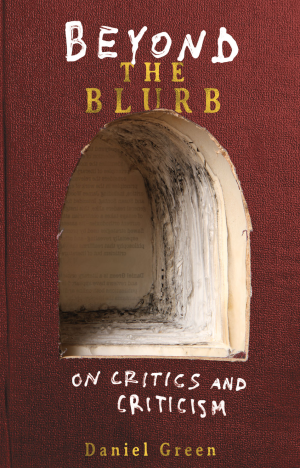
    Anyone looking over my curriculum vitae will see that, while there are a fair number of items listed in the "Publications" section (currently around 140 or so), all but one of them are essays, articles, or reviews, leaving only Beyond the Blurb: On Critics and Criticism (published by Cow Eye Press) as the sole entry declaring itself a book–and even it is a collection of shorter pieces originally published elsewhere, including here on the blog. To anyone asking me if I am a frustrated writer of books who has settled for writing in the shorter forms, I would have to say no. Although shortly after graduate school I did send around a book proposal (not my dissertation) to various university presses, and was offered from one of them a contract of sorts for the exclusive rights, should I actually finish writing the thing, this project never really got off the ground and I eventually just dropped it. Otherwise, I have never actually begun a writing day thinking, "Today I will work on my book."

    Occasionally what seems a pretty good idea for a book comes to me, but quickly enough I'm no longer enamored by the idea and nothing further comes of it. I don't believe this inaction is caused by some kind of a block or a lack of initiative (I'm always writing, just not books). Instead, I think my abilities as a critic–such as they are–are most fruitfully applied to the shorter form, a more circumscribed but also more concentrated space for close reading and succinct analysis. I have always believed that too many full-length works of literary criticism–especially academic books–are padded out with superfluous information and ritualized citations of authorities, although this may just be a reflection of my bias toward text-based explication and analysis rather than theory, biography, or historical critique. Good critics are able to avoid these problems in the best critical books–although many such books are also comprised of previously published essays and articles–but I'm not sure I could be one of those critics, at least while also writing something familiar enough in its form or with a wide enough appeal that it could get published.

    Most of what I want to say about literature (and I do like to think that even in a 1500 word review I am reaching beyond the work at hand to connect it to a literary "issue" or to literary history), I have found I can say in the shorter forms. This does not mean that any such issue can be exhaustively examined or the history fully surveyed in 1500 (or 3,000, or 5,000) words). I have often in fact, addressed the same or similar concerns across multiple reviews or essays, hoping to sound out the topic as fully as possible from different angles. Here the advantages of a book become more apparent. However, I have ventured to collect many of the pieces on common themes in a series of free e-books available through the blog–after concluding no actual publisher would give my collected ruminations on current experimental fiction, for example, even a cursory glimpse–but I'm certain they all gained more readers in their original incarnation as individual items than they have managed to attract through these facsimiles of books. If I'd ventured to write a book about experimental fiction from scratch, it likely would have turned out to be structured much like the e-book, anyway, and surely no publisher would touch this pristine tome, either.

    A propensity for the shorter form was part of my motivation for creating The Reading Experience back in 2004, although I believe this blog actually garnered a reputation for posts a little longer than those on most other blogs, at least back in the antediluvian days of literary blogging. If I had stayed strictly an academic critic, I no doubt would have inaugurated whatever book projects might have been necessary for promotion or to get a better job, or just to stay in the game, but without a game to play, I now envision writing a critical book mostly as something that might happen only when an essay suddenly gets out of hand. Then it would seem a work whose length was an organic development of an idea or analysis that simply required greater amplification.

    Yet an idea for a book has been rattling around in my head for a while, nevertheless, one that would justify its length first by taking the form of an historical narrative–indeed, a history of all of American fiction, from colonial times to the present. But it would also center more narrowly on a progression of works that illustrate the book's argument that American fiction, at least as exemplified by its most accomplished writers, has always been essentially a subversive force, both culturally and formally: American writers have always subjected the country's putative democratic ideals to often harsh scrutiny, and, even more vigorously, have always transgressed against the formal conventions of fiction as those were established by the rise of the European novel (a disposition additionally manifested in the American development of the short story). It would unite my focus on experimental fiction and my longstanding interest in American literary history.

    I would go ahead and write this book if I thought it could be published, but unfortunately.

  • I have sometimes considered writing "personal" criticism–the sort of criticism that embeds discussion of a book or writer in subjective circumstances (the year of reading Whitman!) or connects the work to one's own "life experiences." However, I have always hesitated after reflecting on how little I usually admire such criticism when I do occasionally venture to read it: I really don't care what you were doing the morning you read "Crossing Brooklyn Ferry," and if I wanted to learn about your college years I would seek out your own memoir and not the book you are otherwise supposed to be reviewing.

    (Plus, whenever I have begun a review or critical essay with autobiographical reflections, I quickly rediscover how utterly tedious most of my life has been and that I thus have little to say about it. I can sometimes muster interesting things to say about a book I've read, but not about my life.)

    Arguably the turn to personal or autobiographical criticism became more evident first in academic criticism, as part of the generalized revolt over the past 50 years or so against the academic practices of the previous 50 years (among them "objectivity" and "analysis"), almost all of them ultimately consigned to the dustbin of academic and literary history. (As eventually will be, of course, the practices that came to replace to them–although whether the notion of dispassionate analysis will ever make a comeback is probably more dubious.) The increasing frequency of personal reflection in more general-interest criticism is no doubt less purposeful, the result of some combination of the rise of "creative nonfiction," the domination of reviewing by novelists and poets themselves rather than professional critics, and, of course, the internet.

    It is tempting to say that the latter is the chief culprit, as it is in so many of the other appraisals of the social and cultural upheavals we are currently experiencing, but it seems to me that its primary contribution to this trend has been to provide a great increase in the number of publication sites (including journals meant to replicate print literary magazines and book reviews but also blogs and online reading diaries) for both creative and critical writing, which in turn created the conditions making it possible for more personal essays to be published and creating a need for reputable reviewers. But of course the rise of creative nonfiction, both as a category of publishing and an area of concentration in the creative writing curriculum, was a phenomenon largely independent of the development of the internet and seems explicable mostly as a phenomenon within literary culture, personal expression becoming the predominant aesthetic value. Moreover, the prevalence of creative writers themselves as authors of book reviews surely predates the absorption of book discussion by the internet, and the notion that criticism by practitioners is somehow more authoritative than criticism by those more fully oriented toward, well, criticism, is a failure of judgment by book review editors more than it is a surfeit of qualified critics.

    I would not contend that critical objectivity is always fully possible, nor that literary criticism has no use for subjective impressions. It is possible, however, to describe a literary work under review or analysis with conscientious accuracy, and providing such description has always seemed to me to be one of the pressing–if not the most pressing–obligations of the critic. If evaluation is part of the task in a particular critical piece (a review, presumably), such a judgment cannot credibly be made unless the critic has shown a keen enough comprehension of the relevant features of the text at hand. This sort of attention to the tangible features of the text is what is most often missing from personal/autobiographical criticism, since evaluation still remains, just made more nebulous and subjective than usual. Conventional reviews too often settle for plot summary in place of deeper formal and stylistic explication; personal essays impersonating reviews frequently substitute strings of figurative language expressing the reviewer's readerly sensibility for even cursory plot summary. 

    If readers want some sense of the personality of the reviewer–and I'm not entirely convinced they do: most readers of reviews seem to want a more thought-out kind of reading recommendation–there are ways to convey this without resorting to literal autobiography and personal confession. The reviewer should provide some sense of the standards being used to reach a critical judgment, and this can be done while acknowledging their subjective selectivity–in effect disclosing the reviewer's own aesthetic sensibility as manifested in the assumptions those standards imply. Neither the criteria used nor the application of them to the particulars of the work need to be articulated in a literal, unduly mechanical way–here are the criteria, now watch me apply them–but can be suggested more subtly and indirectly, and executed with a verbal flair and judicious insight that surely draws attention to the critic's individual quality of mind.

    But perhaps the more frequent kind of recourse to the personal or autobiographical in works of ostensible literary criticism is to be found in articles and essays less standardized than reviews, more discursive or exploratory, reflective or ruminative pieces in the form of an "appreciation," reconsideration, or extended critique. Here the temptation to underscore one's response to a writer's work by literally invoking personal reactions and experiences seems greatest, and I do not avow that such a move is wholly illegitimate. If you believe literature can make a difference in people's lives, the evidence from one's own life seems an obvious place to turn. But at some point such exercises become simply personal essays rather than literary criticism, and again my own history of  both writing and reading critical essays tells me it is entirely possible to convey personality and perspective without crossing this line. Close reading or analysis does not require a turgid prose style, nor does it necessarily entail endless quotations and an eye-glazing analytic detachment. The goal should be to be communicate the critic's most concentrated experience of the work, and this ought to motivate his/her most discerning and dynamic writing, not the most pedantic.

    Nonfiction that includes reflections on other writers and writing but is otherwise simply an autobiographical narrative is certainly not encompassed here in my skepticism about autobiographical criticism. I am focusing on literary criticism that incorporates the personal and autobiographical as a strategy for carrying out acts of criticism, often self-reflexively acknowledging the strategy within the piece itself as if to underscore the critical intent. Sometimes the author is simply venturing an experiment with this device, but at other times it seems as though the critic is assuming an implicit assent to such a practice, on the reader's part, but also presumably editors, who may even prefer the personal approach, which is seen in turn as more appealing to readers. The phenomenon seems especially noticeable online (even if its roots lie elsewhere), and to the extent that literary criticism eventually migrates entirely online, traditional exegetical literary criticism may be increasingly shoved aside.

    Since academic criticism has long since abandoned disinterested literary analysis, general-interest publications are really the only venues available (aside from personal blogs) for critics who favor this approach. Without it, we could ask whether literary criticism still exists.

  • Issue three of Long Story Short is now available.

    Includes reviews of:

    Hashtag Good Guy With a Gun (Sagging Meniscus Press), by Jeff Chon

    Bring Me the Head of Quentin Tarantino (Graywolf Press), by Julian Herbert

    Thick Skin (Kernpunkt Press), by N/A Oparah

    Wiki of Infinite Sorrows (Kernpunkt Press), by Matthew Burnside

    Meiselman (Tortoise Books), by Avner Landes

    Free sign-up: https://danielgreen.substack.com/welcome

  • Issue Two

    The second issue of Long Story Short: 500-word Reviews is now available.

    Includes reviews of:

        The Ancestry of Objects (Deep Vellum), by Tatiana Ryckman

       Sea Above, Sun Below (River Boat Books), by George Salis

        The Posthumous Works of Thomas Pilaster (Sublunary Editions), by Eric Chevillard

        Ire Land (a Faery Tale) (Spuyten Duyvil), by Elisabeth Sheffield

        Fucked Up (Expat Press), by Damien Ark

    Sign up.

  • Issue One

    At long last here is the first issue of Long Story Short: 500 Word Reviews. I am still hoping to post issues on a monthly basis, but I did discover this time that, well, first of all you have to read the books before you can review them.

    The books included here are:

    Rituals Performed in the Absence of Ganymede (11:11 Press), by Mike Corrao

    Unidentified Man at Left of Photo (corona\samizdat), by Jeff Bursey

    Ezra SlefThe Next Nobel Laureate in Literature (Tartarus Press), by Andrew Komarnyckyj

    Babel (Splice), by Gabriel Blackwell

    Sign up.

  • What They Refer To

    If any of the writers Jess Row cites in White Flights: Race, Fiction and the American Imagination for their enactments of "whiteness" comes close to being judged as explicitly racist (performatively in his practice, not his personal conduct), it is the editor/teacher/writer Gordon Lish. In his efforts as editor and teacher in particular (Row doesn't have much to say about Lish's own writing), Lish, in Row's analysis, embodies assumptions about style and form that have enabled white writers to avoid reckoning with the cultural legacies of whiteness in American fiction, further allowing them to presume an "innocence" in regard to these legacies that perpetuates an evasion of the responsibility to interrogate whiteness as the default perspective in American literature. Lish is not the only writer to do this–White Flights is an extended rumination on how contemporary writers find ways to carry out the mission–but Row seems to find him a particularly objectionable case.

    Row sees Lish as an inheritor of modernism's antagonism to "ordinary language," which finds its expression in Lish's by now familiar formulation of an approach to style that has come to be called "consecution." This style is best known in the work of acolytes such as Gary Lutz, Diane Williams, and Sam Lipsyte, but Row extends it to cover other writers not necessarily associated with the practice as most memorably described by Lutz in "The Sentence is a Lonely Place": Ben Marcus, Don DeLillo, and even Raymond Carver, all of whom have had some association with Lish. Indeed, the chapter in White Flights devoted to Lish's influence is framed by a consideration of Lish's editing of Carver's story "What We Talk About When We Talk About Love" (originally titled "Beginners"), in which Row examines one particular excision (out of many, we now know) of a brief passage in the original relating an anecdote told by a character whose role is much diminished in the final, published version.

    The anecdote is related to one of the characters, a doctor, by a patient named Henry Gates who, along with his wife, is in the hospital after a car accident (it is part of a more extended episode about these characters, which Lish cut from the story). It is a somewhat sentimental reminiscence of the patient's experience dancing with his wife on wintry evenings in their home in Oregon, presumably meant to add "color" to the portrayal of this character. Row interprets Lish's act of removing such color as an effort to erase this character's social status as poor white (a status shared by Carver while growing up in Yakima, Washington), and thus to eliminate the markers of whiteness in the character. Lish himself, of course, would presumably contest this interpretation vociferously, attributing the cut to the same impulse that led him to so severely pare down so many of Carver's drafts in the first place, an attempt to gain more forceful impact through subtraction of extraneous details, to achieve a kind of bleak objectivity by following the principle that less is more.

    But we can't really know from Row's account what Lish hoped to accomplish in his editing of Carver because Row does not allow Lish–or anyone else who might offer a form or style-based assessment of the effect of his editorial judgment–to explain his choices. Instead he asserts the "violence" of Lish's amputation of Henry Gates from "Beginners" with little analysis of Lish's (or Carver's) motives beyond bad faith and quickly moves on to discussions of Roman Jakobson's examination of aphasia, of the genealogy of "white trash," and of other writers contemporaneous with Carver, some associated with Lish, some not; occasionally he returns to Lish and his pernicious effect on Carver (on American fiction in general), where he amplifies his original contention that Lish's editing of "Beginners" impeded Carver's development as a writer engaged in interrogating whiteness. "What was Lish doing when he struck the story of Henry and Anna Gates from 'What We Talk About When We Talk About Love?'" Row asks during one of these detours back to the ostensible subject of the chapter. "He was erasing, or policing, in part, a gesture toward the particularity of Carver's own whiteness." But again this claim goes mostly unsupported, as he immediately (in the very next sentence) begins a lengthy survey of Raymond Carver's background and the turn in 1980s fiction to "a new kind of American regional writing."

    Row's procedure in this chapter ostensibly on Raymond Carver and Gordon Lish is representative of his method in White Flights as a whole. It is a frustrating blend of criticism, autobiography (in this chapter Row also ponders his own background, as well as his enthusiasm for certain indie rock bands), and digressions on various writers, theorists, and scholars that perhaps provides some rhetorical variation, but also ultimately muddles the book's focus and makes tracking its argument (if if does indeed have an argument) a challenging task. This approach is especially disconcerting in the chapter on Carver and Lish, since Row makes generalizations about both writers that are entirely disputable–and in Lish's case, arguably question his integrity–but offers so little evidence the dispute can't extend beyond bald assertions. (He does this. No, he doesn't.) No doubt such an approach well serves Row's impressionistic purposes, but criticism needs more than cursory impressions.

    Thus the case Row makes for the baleful influence of Gordon Lish unfolds mostly through insinuation. He does not say that Lish has dubious racial attitudes, but certainly implies as much: 

    While the past four decades have seen the emergence of "multicultural literature"–that ambivalent phrase, full of coded resentment–as a significant, even dominant, element of the American literary scene, Lish has operated in a parallel aesthetic universe that deals neither in culture nor multiplicity.

    "Whether Lish deliberately avoided working with nonwhite writers is a significant question for his biographers," Row additionally avers, but, conveniently enough, claims this is not the question he wants to pursue. (Presumably just the intimation will do–again without any evidence to suggest such a charge might be true.) Lish's baneful influence resides in the way his aesthetic permeated writing workshops, where white writers (including Row himself) learned to absorb "a radical practice of shame."

    I confess that this is the element of Row's critique of whiteness in contemporary fiction that I find hardest to understand. It seems to be rooted primarily in Lish's editing of Carver's fiction, but Row also draws on Mark McGurl's analysis in The Program Era, which applies the concept of inherent shame to minimalism more broadly: "If the modern world is a world of risk, a 'Risk Society.'" according to McGurl, "then minimalism is an aesthetic of risk management, a way of being beautifully careful." Presumably this hyper-carefulness represents a reluctance to indulge in emotion, which is prompted less by an aesthetic preference for understatement (resulting in a "beautiful" surface) than a fear of emotional exposure, which in this context is interpreted (by McGurl) as "shame." 

    Although it seems just as likely that such emotional reticence reveals a desire to avoid sentimentality in art rather than emotion per se, it is at least possible to construe the restrained "cool" of minimalist fiction as a fear of emotional disclosure (although in most cases it is really a fear expressed by the characters in the fiction rather than by the author). But Row wants to transform this restraint more broadly into a kind of embarrassment about "identity," using Don DeLillo (whose association with minimalism is, to, say the least, rather obscure) as his quite puzzling example. While it has been claimed that DeLillo's work shows few signs of his Italian-American heritage, Row claims to the contrary that Underworld, for one, "vibrates with an ethnic consciousness that may be suppressed by historical and cultural forces, but is not extinguished and is all the more powerful for being so powerfully repressed, not only in one narrative, but throughout DeLillo's early career. Yet to say so surrounds the book, its characters, and DeLillo himself with radiating waves of shame."

    I find this interpretation literally unfathomable. Is this shame about being Italian-American? About being white? I must say I find the first possibility extremely implausible, and I don't understand how the second would have any bearing on our reading of Underworld. Further, what possible connection could any of this have to the initial kind of shame attributed to Raymond Carver? Row seems to be positing an extraordinarily dispersed "shame" among white writers, so dispersed it becomes a shame without an object–or at least without a purpose that would explain why we should consider it in interpreting their work. When Row also invokes the concept to describe the "shaming voice" of critics who once warned him off of overly tendentious or sentimental writers, the term has been extended beyond any useful meaning as a tool of analysis.

    Even if we accepted that something like shame subliminally influences some writers' choice of subject or representational strategy, by the time we have gotten to the end of this chapter and its summative conclusion about shame–"White writing is a covenant, a shared understanding, about what is sayable and what is unsayable and not allowed"–we have come a long way from the opening gambit adducing Gordon Lish's editing of Raymond Carver as an episode in need of explication. Along the way, much mischief has been attributed to Lish, an outsize authority bestowed upon him, with very little in the way of credible evidence to support either. To be sure, anyone not previously much familiar with Lish's career would probably from Row's account adjudge him to be a nefarious figure nevertheless, responsible for perpetuating very retrograde attitudes among American writers.

    It is likely, however, that the real object of Row's disdain is not Gordon Lish himself but what he represents, that antipathy for "ordinary language," his belief in the literary as artifice. As Row also puts it:

    The faith Lish professes–and it's clearly a faith–has to do with an immanent quality of words and sentences, a kind of radical non-instrumentalism, which insists on treating words not as dependent on what they refer to but as entirely self-sufficient and beautiful in themselves.

    While I would not go so far as to say that Row presents Lish as a postmodernist, a proponent of the formally unorthodox in fiction, he does here cast him as an aesthete, someone more interested in the beauty to be made of language when cultivated for its own sake in literary works than in its objects of representation. Aestheticism is highly out of favor in today's literary/critical climate, its self-imposed detachment from social realities possible only as a move unavailable to writers and readers entangled in those realities. Lish is someone indifferent to such readers (and writers who want to reach them), who doesn't appreciate that sentences are not self-sufficient but need to be sent "out of their loneliness and back into the world where they belong."

    Is a concern for the aesthetic qualities of literature–the belief that literary art is first of all art–inherently an insular, protected outlook that allows indifference to "the world" and its injustices–and therefore available only to white writers? Aren't Gordon Lish's attempts to transform "ordinary language" actually the same attempts, in principle if not in their particulars, made by all writers, fiction writers and poets alike, in their shaping and figuration of language beyond the straightforward effort to "communicate"? Aren't these sorts of transformations the very essence of literature? If Jess Row wants American fiction in the future to be "reparative," I can't see at all how asking writers to abandon literature contributes to the cause.

  • It could be argued that the strongest rival to autofiction as the most noteworthy tendency in current American fiction is its effective opposite: non-genre fiction that distorts reality through fantasy devices that create fabulous worlds–"fabulous" as in suggestive of fables. Some of this fiction is indeed reminiscent of fables and fairy tales, while other such works make less use of allegorical narrative while still creating worlds that are essentially surreal. If the former renews a kind of story as venerable as storytelling itself, it perhaps is most immediately rooted in the fiction of a writer like Angela Carter, who performed arresting variations on recognizable motifs and themes drawn from the fabulist tradition. The latter are essentially a recent permutation, less tied to narrative conventions, more freely imagistic and amorphous. The fiction of Blake Butler might be put into this category.

    Sarah Rose Etter's The Book of X more appropriately belongs to the first category. It takes place in a make-believe world (although retaining enough similarity to our own that it doesn't cross over into a purely hallucinatory surrealism) in which it is possible for a girl to be born with a torso tied in a knot (as had her mother and grandmother) and for her family to be in the meat business–meat they harvest from underground chambers where it grows on the wall. The narrative seems to follow a trajectory by which the girl, Cassie, after a life spent struggling with the hardships her condition unavoidably imposes, seems ultimately to face the possibility of redemption, of a happy ending to her story, but even after undergoing an operation that undoes her knot and offers her the possibility of a more "normal" life, contentment continues to elude her, and the novel ends with Cassie's apparent suicide. Thus while we are perhaps led to expect the sort of happy ending that usually concludes a fairy tale, The Book of X  subverts those expectations, to the extent that some readers might find it shocking (certainly distressing).

    But this deviation from presumed narrative direction is actually the novel's most important move. Not only does it work to avoid the sentimentality that might accompany an unqualified fidelity to the conventions of the fairy tale narrative–indeed acting instead as a useful corrective to those conventions–a happy ending would likely diminish the book's thematic resonance, suggesting that the  hardships and suffering experienced by the protagonist can be mitigated easily enough, that the harm done to her is ephemeral and not a necessary source of her identity. Because of her circumstances, Cassie can be seen as emblematic in several different ways, most obviously as a disabled person but also as a young girl struggling with socially imposed "body issues," as a young woman succumbing to depression, and a "fairy tale ending" to her story would seem to rob her character of its evocative associations, if not actually defeat the purpose behind the plot and character devices employed for most of the novel.

    Although the method by which Cassie tells her story is unorthodox–highly fragmented (with attention given to the spatial arrangement of the fragments), interspersed with "visions" in which, generally speaking, Cassie imagines an alternative to the life she is actually living–the story itself proceeds (in the present tense) chronologically through Cassie's life. In its broadest outlines, her life is relatively uneventful, if often melancholy and full of disappointment–most of the narrative's interest lies in Cassie's psychological turmoil and in the vividness of the surreal fantasia of many of the visions. (In one episode, she visits a "Man Store," where she buys half of a man (top half) because it is all she can afford, hoping to buy the other half later.) The first third of the book chronicles Cassie's youth, the second her attempt to build a life for herself after moving to the city, and the final third her relocation to an isolated cabin in the mountains in the aftermath of her operation.

    Cassie's parents are depicted as more or less familiar sorts of parental figures, despite their ostensibly bizarre circumstances. Her mother suffers the same affliction as the daughter, but seems to have accepted her lot and raises Cassie to do so as well, although Cassie frequently expresses frustration with her exacting expectations. Her father at first seems distant and damaged, but it is the father to whom Cassie ultimately seems most strongly connected, and it is his death near the novel's conclusion that leads her to what seems her final unhappy act. While seeking out her independence in the city, Cassie as well maintains a basically ordinary existence working a routine office job, although she does acquire the habit of picking up men in bars. While some of them are indeed taken aback by Cassie's knot (one leaves her apartment immediately), nothing particularly untoward happens, just more discouragement and disappointment. After moving to the cabin she does fall in love with a married man named Henry, but her passion dissipates when her father dies.

    Thus Cassie's apparent suicide–she takes some "white pills," and in the novel's concluding sentence tells us that "My eyes fail and my eyes widen, all pain finally gone" as she confronts "the wide bright mouth of death"–for the attentive reader does not exactly come from nowhere. Her experiences have left her vulnerable to despair after her father dies, and it is as if she recognizes that  the apparent realization of her quest for conventional happiness is inauthentic, romanticized wish fulfillment, in comparison to the grief she feels, a grief that is all too real. She falls into what is quite clearly an incapacitating depression:

    These are the days of nothing: slow motion, under water, distant from other bodies, other thoughts, other humans. I stop wanting and become very still. I want to cut my life off at the legs.

    That Cassie succumbs to this depression is surely disturbing, but it seems clear enough throughout the novel that she is, in the words of David Foster Wallace, a "depressed person."

    It would seem, then, that Etter refuses to conclude a chronicle of depression with a happy outcome even more than the story about overcoming adversity the novel superficially evokes. Yet in most ways The Book of X still performs the same sort of signifying function we associate with fables and  fairy tales. To ultimately subvert narrative conventions is not to dispense with them entirely–they still condition our response to the story's development. And the surreal elements, particularly the fantastic transfiguration of the protagonist's body, are quite clearly designed more for their metaphorical  than for their tonal effect or creation of character (although Cassie is nevertheless a memorable and convincing character). We might even say there is a "moral" to Cassie's story, if a sobering one: things don't always work out.

    I must say that of the two kinds of non-realist fiction described above, I am usually more impressed with works of the second kind, as the narrative-driven fabulist fiction often veers closely to didacticism, of using fiction as a means to "say something." This is unavoidably the case with The Book of X as well, although I would not say that it is overtly didactic. The impression it leaves most firmly is that of a skillfully directed act of imagination that is itself still the most important point.

    Box

Essays in Criticism

Unbeaten Path
Unbeaten Paths: Reviews of Adventurous Fiction