A book with pages fanned out sitting on a dark wooden table, set against a white background.

The Reading Experience

Daniel Green’s Blog and Website

  • .pdf version

    University creative writing programs have proven to be a conservative force in literary culture, for reasons that probably could not have been avoided. Once these programs reached such a level of ubiquity that virtually all aspiring writers enrolled in writing workshops, the most ambitious pursuing an MFA degree as a matter of course (not to mention ultimately teaching in a creative program as well), it was almost inevitable that the collective “Program” would assume the task of regulating practice and enforcing norms among its graduates—who are overwhelmingly the authors of most published literary fiction, at least in the United States. Since most “little magazines”—whose numbers have proliferated at an astonishing rate over the past 20-years, particularly as these journals migrated online–exist primarily to provide a place of publication for Program writers (who need such publications to secure and maintain jobs among creative writing faculty), that “serious fiction” would reflect the assumptions of creative writing instruction should not be surprising.

    It is not coincidental that from the time creative writing programs really began to expand in the 1960s and 70s to the present, the “cutting edge” in American fiction has shifted from the formally challenging work of postmodern writers such as Donald Barthelme or Gilbert Sorrentino to fiction featuring previously marginalized or unheard writers or characters, much of which tends to emphasize subject and content and is mostly conventional in form. An increasing aesthetic conservatism among students and instructors in creative writing programs cannot, of course, alone account for this movement from formal innovation toward a greater emphasis on theme. (Nor is this separation between manner and matter necessarily as stark as these generalizations might imply: some postmodernists used formal or stylistic experimentation as the best way to evoke complex subjects, while many current writers are as attentive to form as to content.) However, to the extent that the university writing program increasingly became an instrument of professionalization, the preparation of students for a career in writing and writing instruction, it was destined to exert an increasingly conservative influence.

    The varieties of this influence (and they are expressed in discrete ways that seem to go unnoticed because they so integrally inform creative writing practice) can be seen in three books conveniently published at about the same time in 2021: Matthew Salesses’ Craft in the Real World: Rethinking Fiction Writing and Workshopping, Lisa Zeidner’s Who Says?: Mastering Point of View in Fiction, and George Saunders’s A Swim in the Pond in the Rain. These books 2reveal the by now fixed assumptions about both workshop practice and the aesthetics of fiction that have shaped the “disciplinarity” of academic creative writing, and are likely to determine its legacy in whatever future serious fiction might still have remaining—likely outside the academy, moved aside along with all the other humanities disciplines as the university ever more obediently submits to its political and economic overlords.

    The most conservative of these books is Salesses’ Craft in the Real World, even as it presents itself as something of a revolutionary manifesto. Salesses wants to transform the notion of “craft” to more properly suit the needs of a changed clientele (and a modernized faculty as well), but his effort merely replaces one set of critical precepts based on abstracted technique with another based on political and sociological doctrines derived from a generalized concept of cultural difference. If anything, the new rules Salesses lays down for the conduct of the writing workshop are even more rigid and uncompromising than the ones they are to replace: Under the old dispensation, the consequences for disobeying the rules are merely the disfavor of one’s peers and the skepticism of the marketplace; under the dominion of the new, one is likely to be regarded as morally derelict and exiled to the land of lost souls—although, given the sort of strictures Salesses’ revamped writing course would impose, it is no doubt the instructor who would be most subject to the sanctions in force.

    Salesses wants to bring the writing workshop out of its fixation on mechanical details and a false claim to universality (“‘Pure Craft’ is a Lie” proclaims the title of the first chapter) and instead make it face the concerns of the “real world.” This is, of course, the world as understood by the workshop’s diverse and varied students. To adapt ourselves to this world will require a wholesale transformation of the concept of craft, since craft as we have known it until now “is part of the history of Western empire that goes back even to the Ancient Greek and Empires, upon which American democratic values are based.” Salesses’ ambitions thus are radical indeed, to help literature do its part in disassembling Empire by overturning the reign of “craft” as it has been regarded until now.

    But has craft in the definition of the term Salesses wants to use, as an assemblage of well-know guidelines used by “Western” cultural gatekeepers to enforce an insular perspective on the nature of literary writing, actually held dominion over the course of Western literary history? To say that Salesses does not provide much in the way of evidence or illustration of this central assumption of his book would be a lenient way of putting it. Aristotle and E.M. Forster are really the only examples he cites (both on plot) of historical figures formulating or perpetuating the principles of craft, but of course neither of these men would have understood their comments to have anything to do with craft, even if we were to update them on how we currently use the term. We should in fairness likely assume that Salesses is knowingly simplifying, for rhetorical convenience, the relationship of such figures to what he is calling craft, but still it is difficult to imagine Aristotle believing that what he was doing in the Poetics was providing advice to writers about how to do their job.

    If there are examples of establishing craft rules in Western literary history, most of them during most of this history would apply to poetry, but Salesses doesn’t discuss poetry or the appropriate conduct of poetry workshops at all. Whether he would acknowledge that poetry does have certain canons of procedure that are more or less consistent across languages and traditions—canons that are necessary for the genre to exist in the first place—is thus uncertain, but it would seem to be a devaluation of fiction as a form to say that it does not call for the same sort of consideration of intended verbal effects as poetry, to deny that some essential features of prose narrative are recognizable to almost all humans. If Salesses is not resisting the salience of the traditional “elements of fiction”—the devices that allow for the full embodiment of narrative—but certain ritualized applications of those elements, almost their fetishization, the solution would seem to be to no longer apply them, to abandon the fetish.

    But however much Salesses professes to want a different version of craft than the one putatively dominating creative writing workshops, he does not propose doing without craft as either an approach to the creative writing classroom or to the critical consideration of fiction in general. It is somewhat difficult to see why: Salesses objects to the way craft-talk excludes writers with a different understanding of fiction’s purpose and possibilities that traditional craft does not accommodate, but such writers include not only those with non-Western cultural inheritances but many writers from within the Western cultural tradition who also find the imperatives of craft confining and alienating. Many of these writers deliberately avoid the institutional machinery of the academic creative writing Program (although some are just excluded), but even those holding out for the benefits of a creative writing degree might ask of this book and its author why exchanging one set of restrictions on the writer’s creative judgment and imagination for another is necessarily an improvement.

    Most of Salesses’ directives, in fact, have little to do with “technical” matters encompassing style or form. They seem designed primarily to focus the writer’s attention on content—more specifically, on the “world” to which the work points and away from the individualism of either character or author-as-artist. Thus, “whether positive or negative, fiction always says something about how we live, and not in an individual sense but a contextual one. When we write fiction, we write the world.” And, “it’s about time that individual agency stops dominating how we think about plot or even causality.” This is because “being in the world is much more about dealing with effects than with causes.” As a student himself, Salesses tells us, “story arc was always presented to me as something more like plot, something like how the character’s situation changes or fails to change. . .It might be more useful to consider instead how the world is changed or fails to be changed.” Since the purpose of Salesses’ redefinition is clearly to minimize—if not eliminate—attention to the elements of fiction that highlight instrumentalized “method,” it is at first unclear why Salesses retains such a term as “story arc” rather than just dispensing with it.

    If what Salesses—and other like-minded critics of current literary education—really wants is a learning environment free of traditional craft conventions, which they believe unduly inhibits some students from fully realizing their artistic visions, he ought to declare that there are no rules the writer must learn to follow, that in fact as long as such rules continue to be assumed, it should be entirely appropriate to break them. He should insist that the very notion of “craft” entails a conception of a unitary “art of fiction” that is bound to exclude any writer who resists the officially approved practices. What better way to ensure that the aesthetic preferences of all student writers be fairly considered than to simply relinquish the idea that to “learn” the art of fiction involves adopting the right assumptions and procedures, developing a suitable facility with whatever approach the currently established authority favors? Artificial distinctions between genres and modes, including the unhelpful distinction between “mainstream” and “experimental” fiction would collapse: all efforts to write a work of fiction would be experimental, attempts to sound out the possibilities of the form without conforming to any one conception of its proper mission.

    Something tells me, however, that this is not what Salesses has in mind. Too much of the work would be left to the students to read widely and discover how other writers have redeemed these possibilities. The teacher could no doubt assist in this process of discovery, but that would require suppressing narrow beliefs about the function of literary art. While many creative writing teachers would certainly be able to accomplish such a task, it seems unlikely that Salesses, for one, with his stringent view of developing writers who “think critically about how they are working with and contributing to culture” would be prepared to discard this imperative. Salesses is too committed to the transformation of the fiction workshop into a reflection of the cultural multiplicity of “the real world” to give much attention to the critical multiplicity of fiction’s aesthetic projects.

    The strength of Lisa Zeidner’s Who Says? is that she does attempt to account for such multiplicity, at least in the use of point of view. Zeidner covers each of the main types of point of view, differentiating in detail both third-person omniscient and the third-person limited (“central consciousness” or “free indirect”), as well as the issues that emerge in the use of first-person (reliable vs. unreliable, the rise of the self-conscious narrator, etc.). She also devotes space to the less common (although in some cases increasingly common) exercises in point of view (second-person, the communal “we,” “whiplashing” point of view), child as well as non-human narrators, and compares the effects of point of view in fiction and film.

    Zeidner also has what is essentially a thesis about the importance of point of view: point of view is the most important consideration in fiction, involving “skillful manipulations in, and motivations of, your alliance with your characters,” manipulations that are “more central and crucial than plot.” She emphasizes the centrality of point of view in an initial chapter that examines the impression created by first lines and paragraphs: “My argument is that point of view in good fiction is embedded in every choice about tone, description, and diction, even about plot and pacing, and furthermore it has to be established very quickly.” One could disagree with Zeidner about the foundational status of point of view in prose fiction (as I do: surely style, the particular way language is ordered for effect, is even more primary) while still acknowledging that Zeidner has identified and explicated more comprehensively an element of the art of fiction that is often treated more cursorily than it deserves.

    Who Says? ranges widely in its choice of sample texts, especially across genres and modes. The author clearly also makes the effort to reach across “cultures” in Salesses’ sense of the term (Susan Choi, Percival Everett, Junot Diaz, among others). Point of view is an aspect of craft that Salesses actually does not much discuss at all, and it is hard to know whether it is simply an element of fiction he takes for granted without submitting it to a critique of its real-world relevance, or whether as a purely “technical” issue, it is inherently too far removed from the “real” world to which Salesses wants fiction to be faithful that it simply evades the reach of his critique. If point of view is as crucial to the way fiction works as Zeidner would have it, however, Salesses’ notion that craft in its traditional guise is wholly irrelevant (even destructive) to the present and future direction of both fiction and creative writing instruction is altogether unfounded. The sorts of choices confronting the writer of fiction in achieving the most artful effects that Zeidner surveys in fact seem the craftiest of craft decisions.

    Still, because of the relatively comprehensive treatment Zeidner provides, Who Says? would be the sort of book that might be used with students in presenting them a wide spectrum of possibilities relevant not just to point of view but to the creation of effects in fiction that in general expand the writer’s (and ultimately the reader’s) focus of attention beyond plot and character (while also obviously contributing to both). Zeidner does not take any strong position on the advisability of venturing a particular effect, although she does point out how some point of view choices work better than others for producing some particular effects, and thus the book does indeed offer young or inexperienced writers an abundant selection of approaches to point of view for inspiration or emulation. However, this very impression of a kind of exhaustive sampling may actually encourage such writers not so much to perform their own variations on these models but to imitate them. This is surely not Zeidner’s intention, but may in fact accentuate an inherent limitation to the efficacy of academic creative writing instruction.

    The widespread establishment of creative writing as an academic field of “study” (by its nature creative writing is really closer to a professional program than a true academic mode of inquiry) quickly enough, if predictably, developed its own hierarchy of programs (perhaps with the Iowa workshop at the top), and from there a relative uniformity of practice—eventually the instructors were usually themselves the products of creative writing programs. In such a setup, it would surprising if the long-term effect was not a substantial degree of conformity among those making their way through this system. Such conformity would indeed arise at the level of craft, since craft is something that presumably can be taught, Under the circumstances, “craft” acquires preeminent importance—so important that a writer like Matthew Salesses sees control of its operating assumptions as a compelling source of cultural power, “rethinking” its definition akin to an act of political revolution. But the successful transformation of the creative writing program in the manner Salesses envisions will change only the terms of compliance with the norms of the Program, not the reality.

    Outside of its possible use in a creative writing course, Lisa Zeidner’s book on point of view certainly provides interested readers with a breadth of coverage of the various options available to the writer of fiction when thinking about the enactment of point of view, but it is not really a book that probes very deeply into the potential transmutations of point of view that can make it a source of literary innovation and originality. You can gain a great deal of valuable insight about the application of point of view to the overall configuration of works of fiction from Who Says?, but not about how a writer can disregard the standard approaches taken by the preponderance of professional writers and discover a less-travelled path to follow.

    George Saunders’s A Swim in the Pond in the Rain is essentially a craft book, pursuing “craft” more or less in the apolitical inherited understanding of the term Matthew Salesses wants to disown. But Saunders approaches teaching the principles of good writing from an unorthodox angle, offering a course (this book is a version of it) that looks closely at a few stories by the 19th century Russian masters of the short story—Chekhov, Turgenev, Gogol, Tolstoy. Saunders moves methodically through each story, querying students about how the stories seem to be working on them. Saunders in the book often summarizes their responses, but he is more likely simply to move right to his own explication—done in an affable, humorous tone that perhaps readers expect from him. The overall impression created by Saunders’s leisurely walk through these stories is not of a teacher giving instruction but an enthusiastic reader drawing on his own experience as a writer to help us appreciate the stories’ effects.

    The biggest drawback to Saunders’s admittedly engaging pedagogical strategy, at least in its implications for understanding the art of fiction, is of course that for English speakers these works are in another language. Certainly much can be learned about the structural order of fiction from the likes of Chekhov and Gogol, but inevitably the linguistic subtleties of their work remains inaccessible to those who read it only in translation, and such intricacies of structure and style is important not only in recognizing the full artistry of these Russian writers but in appreciating that form at its most fundamental level is realized through style—the writer’s particular way of shaping language. Of course, even Russian readers cannot finally learn to write “like” Chekhov or Tolstoy, but the broader sensitivity to the reverberations of language a writer’s style can provide seems like something a serious writer would want to cultivate.

    The strengths and weaknesses of A Swim in the Pond in the Rain are well-displayed in the book’s first two chapters, on Chekhov’s “In the Cart” and Turgenev’s “The Singers.” The chapter on “In the Cart” is the most systematic demonstration of Saunders’s approach to teaching the Russian writers, as he moves page by page through the story, contemplating Chekhov’s technique and speculating about the effects he seems to be after. Saunders also uses the story to draw conclusions about the nature of stories and the writer’s objectives:

        We might think of a story this way: the reader is sitting in the sidecar of a motorcycle the writer is driving. In a well-told story, reader and writer are so close together that they’re one unit. My job as the writer is to keep the distance between motorcycle and sidecar small, so that when I go right, you go right. When I, at the end of the story, take the motorcycle off the cliff, you have no choice but to follow. . . .

    Although Saunders is absolutely correct, here and throughout the book, to emphasize the importance of the reader’s experience of a work of fiction, the implication in this motorcycle conceit is that such experience is most intensively directed to plot, an assumption that is sustained throughout the analysis of “In the Cart,” at least insofar as the focus of attention remains on what happens. Indeed, “what happens” is very consequential in Chekhov, since our grasp of character must depend on our alert apprehension of what they say and do, usually in ordinary moments, but a consideration of what a Chekhov story has to offer an aspiring writer might also stress the way Chekhov is able to build such resonance into stories that are so minimalist in both structure and tone. This is something that happens beneath or around the narrated events themselves, not in the story as such.

    Saunders’s method works somewhat better in the examination of “The Singers,” since this is a story in which what happens is clearly the focal point—although the reader may be more preoccupied by the story’s lack of action (aside from the singing contest to which the narrator’s account leads and the narrator’s approach to and exit from the scene he describes, what happens is almost literally nothing) than by contemplating the narrative. But in this case Saunders’s effort to understand the singing contest and its ramifications prompts him to compel our attention on the details of the contest (on the details in general), in turn making the story’s aftermath take on increased importance. Saunders ultimately affirms Turgenev’s emphasis on description rather than narrative, characterizing it as Turgenev’s disinclination to accommodate contemporaneous notions of “craft” emphasizing plot. (Noting here that description is a compositional mode about which Matthew Salesses again has very little to say.) He might have gone farther, in the discussions of both Turgenev and Chekhov, and reminded us that each of these writers is considered an important figure in the development of literary realism, which in its classic form is meant to expel all conceptions of craft, leaving only life.

    But, as Saunders observes at the beginning of the chapter on Gogol, close reading of stories such as “In the Cart” and “The Singers” shows these ostensibly realistic stories to be “compressed and exaggerated, with crazy levels of selection and omission and shaping going on in them.” If in Turgenev and Chekov these distortions are in the service of a greater fidelity to the “feel” or ordinary life, in Gogol’s “The Nose” the distortion isn’t hidden in “selection and omission” but is a blatant artifice the reader can’t miss. Saunders is perhaps at his best in this book in the analysis of “The Nose,” but this isn’t really surprising, since Saunders as a writer of fiction is closer in spirit to the representational breaches in Gogol than the other writers examined in this book. Saunders maintains that a story such as “The Nose” should not be regarded as absurdism or fantasy, but as a work that depicts “the process of rationality fraying under duress” in a way that reveals a more essential reality going beyond “the way things seem to how they really are,” no doubt similar, Saunders would say, to the way his own fiction incorporates the surreal and absurd.

    In this chapter on “The Nose,” Saunders does address the limitations of reading a writer like Gogol in translation, since in particular much of the humor in the story lies in Gogol’s use of the Russian language. But he does perhaps get as close to Gogol’s Russian prose as we are likely to get by focusing on Gogol’s invocation of the “skaz” mode of narration—featuring an unreliable narrator speaking in something closer to an oral than a written idiom—and by emphasizing Gogol’s creation of voice. The instability of the voice (half formal, half awkwardly demotic), Saunders argues, points us to an instability in the human use of language:

        Language, like algebra, usefully only operates within certain limits. It’s a tool for making representations of the world, which, unfortunately, we then go on to mistake for the world. Gogol is not making a ridiculous world; he’s showing us that we ourselves make a ridiculous world in every instant, by our thinking.

    This is surely a valuable lesson about the writer’s medium for the apprentice writer to learn, and if in his course Saunders offers the kind of thorough analysis found in this book, students must indeed emerge from it more enlightened about craft as employed by these great Russian writers. A course such as the one Saunders teaches seems to me, at least, a better way of emphasizing “craft” than the entrenched workshop method. That it would not pass muster with Matthew Salesses seems like the most severe judgment on the merits of his “rethinking” of the principles of fiction and the teaching of writing.

  • It seems accurate to call Jen Fawkes, at least on the examples offered by her first two books, Mannequin and Wife and Tales the Devil Told Me (the former published in 2020, the latter in 2021) a fabulist, in a line of fabulist writers that has been joined by more and more writers over the past 20 years or so. Perhaps the emergence (or reemergence) of the fanciful and dreamlike in American fiction–to call this sort of fiction "surreal" would tie it too closely to the 20th century literary movement that made the term popular, with which it really shares only a preference for the distortion of reality–can be understood as a reaction to the rise of minimalist neorealism as the prevailing practice in the 1970s and 80s. But while among those adopting fabulation as an approach could be counted a writer such as George Saunders, the practice seems to have been especially appealing to a burgeoning number of women writers, who have found it more compelling than realism as a way of representing women's experiences, especially as way of challenging social, cultural, and psychological stereotypes.

    Although the current writers we immediately identify with such a tendency might include, say, Aimee Bender and Karen Russell, arguably the real precursors to this mode of contemporary fiction are, arguably, Angela Carter and Rikki Ducornet. Their work directly invokes fables and fairy tales, evoking female sexual desire in a way that seems in tune with the liberatory cultural energies of the times (1960s/70s) but also, given expectations of women writers before them, still seems truly transgressive. Their fiction has a complexity and allusiveness that transforms the elemental simplicity of the fabular into a poetically suggestive kind of tale that retains the allegorical ambience of the fable but conveys meaning indirectly through the beguiling potency of the imagery. Subsequent writers showing the influence of the approach taken by Carter and Ducornet have affirmed the pursuit of an "alternate reality" as a valuable strategy in evoking facets of women's lives largely glossed over in American fiction, but the depth of vision to be found in the earlier writers is more difficult to emulate.

    Jen Fawkes seems more inclined to the complexity of perspective found in Carter and Ducornet, even if at first glance the stories in a book like Tales the Devil Told Me might be characterized as simple reversals of the viewpoint associated with traditional fairy tales (substitute as protagonist the evil character for the good one). The first book, Mannequin and Wife, does not so explicitly cross over into the fabular world of make-believe but instead injects elements of the fabulous and the uncanny into what might otherwise be ordinary situations, as in "Sometimes, They Kill Each Other," the first story in the book (told in the plural first-person by the secretarial pool), in which the executives in a corporate office express their competitive impulses by literally engaging in duels staged in the office for the spectatorial pleasure of everyone assembled. In "Iphigenia in Baltimore," the "strength" of the title's mythical character is again literally figured in the story's protagonist, a fourth-grade teacher described as the "strongest woman alive" who must refrain from romance out of her fear she may unwittingly injure her partner, as once she had done in the throes of passion, wrapping her legs around her would-be lover and crushing his pelvis. 

    Other stories in Mannequin and Wife are less fanciful, although still disposed to the odd and eccentric. In "Rebirth of the Big Top," the owner of a drive-in theater begins to hire the former employees of a defunct Sideshow Carnival ("Miranda the Elephant Girl," "Julius the Lobster Man"), whose presence begins to revivify his business. The protagonist of "Call Me Dixon" (ultimately an  unreliable narrator, to say the least) assumes the identity of a code-breaker (whom the narrator tells us he found dead by suicide) during the London blitz of World War II, but discovers that he is not the only one who might be suspected of operating under a counterfeit identity. In general the stories in this book effectively contest the boundary between the real and the fabulous, but ultimately they are somewhat various in tone and structure, ranging from paragraph-long flash pieces to longer stories (such as "Call Me Dixon") that have the looser discursive structure (if not the length) of a novel rather than a more strictly controlled linear narrative.

    The stories in Tales the Devil Told Me also vary in length (the longest story in the book, "The Tragedie of Claudius, Prince of Denmark," Fawkes's retelling of Hamlet from Claudius's perspective, is almost novella-length), but the stories are thematically and structurally unified by the book's underlying conceit: the stories are essentially "twice-told tales" by which well-known fables, fairy tales, and other famous narratives are retold from the point of view of the stories' ostensible antagonists or narrative foils. The recompositions include the stories of Rumpelstiltskin (of a race of creatures called "rumpelstilts), Peter Pan, and Hansel and Gretel, as well as more modern works such as Moby-Dick, The Jungle Book, and Daphne du Maurier's Rebecca. Some of the narratives retain their original settings, while others are updated to a more contemporary scene ("Never, Never" is a sequel of sorts to Captain Hook's sea adventures, after he marries and settles down in an American suburb). Almost all of them intelligently and provocatively explore the potentially more complex and ambiguous imagined realities of characters who in their original incarnations played the narrower and more reduced role of villain.

    Especially effective in realizing this ambition are "The Tragedie of Claudius" and "A Moment of the Lips," the latter the story of Polyphemus the cyclops and his encounter with Odysseus and his crew on their voyage back to Ithaca. It could be said that "Claudius" humanizes Claudius just by showing that, perhaps, there is another side to the story of Hamlet père's  betrayal, necessarily inaccessible to the son, but the effort doesn't really critique Shakespeare's lack of interest in this other story; rather, it illuminates the way in which Shakespeare had to ignore this part of the story so that his play could focus on the psychological deterioration of the title character–and thus fulfill the requirements of tragedy. As with many of the other pieces in the book, by providing us with an alternative version of an established story, Fawkes highlights the artifice of story, perhaps prompting reflection on the contingencies in narrative, the varied purposes that determine both what is built into a story and what is left out. "A Moment of the Lips" makes us especially aware of the stark differences between the requisites of epic narrative and those of modern psychologically-directed fiction. Polyphemus doesn't mean to eat Odysseus's men: he just can't seem to escape his cyclops nature. His actions appall, but his sincerity appeals.

    Fawkes reports that she will be following up these two collections of short fiction with a novel that sounds like it will continue in the fabulist mode but also be formally adventurous in a somewhat more conspicuous way (Tales the Devil Told Me in particular relies necessarily on essentially traditional narrative conventions). This surely is something worth anticipating, after this very engaging pair of first books.

  • The stories in Marcus Pactor's Begat Who Begat Who Begat (Astrophil Press) situate themselves in the domain of domestic realism–family responsibility, particularly on the father's part, underscored by the book's title–but they are realistic only in their underlying emotional fidelity to the complications and anxieties induced in both parents and children by ordinary family life. They are fantasias of familial unease, transformations of recognizable family dramas into askew parables of parental confusion. Although there is certainly a palpable sense of urgency connected to the various characters' attempts to cope with the attendant obligations of their circumstances, ultimately these situations seem to serve more as the sources of the stories' narrative flights of fancy and formal variations than of novel insights into prevailing family dynamics.

    The fathers in these stories are engaged in the most mundane sort of fatherly activities: installing toilets, mowing lawns, sorting screws in the garage. But the toilet somehow starts flushing up toys, jewelry, and other favors, the lawn mower begins speaking to its rider, and the screws, it turns out, are for a box inside of which the narrator is attempting to preserve the family's dead dachshund. Several of the fathers construct elaborate defenses against thinking directly about their parental fears. One engages in a disquisition on artificial intelligence (especially android bodies) as a way of displacing his anxiety about his daughter's budding sexuality. Another thinks constantly about food as a distraction from thinking about the loss of his family through a divorce. One is obsessed with bugs and other vermin after moving in to a new home, which seems a manifestation of insecurity in his masculinity (his wife appears to be the sexual aggressor in the relationship, and his neighbor, Dave, treats his lack of household handiness with some condescension). Some such implicit apprehension, in fact, seems to beset most of the protagonists in Begat, which Pactor adeptly exploits throughout the book for its comic effects.

    Quite a few of the stories conspicuously employ unconventional structures and adventurous formal devices, although a focus on family dynamics and paternal equivocation remains prominent. "Archeology of Dad"–in this case recounted by the son about the father–departs from a present-day setting and relates the story of the narrator's father, a lesser-known neoconservative writer and intellectual of the Reagan-Bush era. The story of the father's rise and fall from grace as an influence at the Reagan White House is punctuated with textual "holes," which the narrator son uses to, in effect, spy on the otherwise unspoken "backstory" of the recollected narrative he is assembling. In "My Assets," a college-age daughter takes stock of her life by toting up her "assets" while reading her Econ 101 textbook. In an equally indirect manner, a father in "Do the Fish" considers his own rather confounding circumstances: his daughter has forsaken him for the mothering of a trans woman, Olive, who until recently had been the father's lover. The story is coaxed out of the father as responses to a questionnaire of sorts, although it remains uncertain just who is directing him to respond–quite likely himself. In a story that combines the graphical insertions of "Archeology of Dad" with the question-answer format of "Do the Fish," "Remainder" presents a dialogue between two men, Q and P, who discuss "American daughters" (as well as their recently deceased neighbor) in a less than fatherly way.

        The father in "Sponsors" is also somewhat less than fatherly. "While his daughter was out on a date," it begins, "Berg went to her apartment, slept with her roommate, and left with his head shaved to skin." We don't really get much in the way of follow-up to Berg's introductory transgression, as the story depicts his generally aimless activities in its wake–related by a friend, who by the end of the story actually usurps attention away from Berg to his own concerns. "More Fish than Man" is not the only story in the book to hint at same-sex attraction on the father character's part (in one story, more than just a hint), in this case seeming to directly link it to the doubts about the performance of masculinity expressed to a greater or lesser degree in numerous stories in Begat. The final story in the book, "Known and Unknown Records of Kip Winger," appropriately enough recapitulates some of the more prominent motifs employed throughout Begat Who Begat Who Begat: a protagonist uncertain about his masculine libido in contrast to his more sexually adventurous wife, a problematic relationship between the protagonist and his own father, a father anxious about his own parenting skills. At the story's conclusion. the protagonist (here named Bergen) envisions three scenarios for his future, in each of which his wife leaves him. "He understood that Eva would leave no matter [how much he endeavored to keep the marriage intact]", leaving perhaps a final, sobering impression of the fragility of family.

    By the time we have reached this concluding story and its concluding flourish, the book's title has come into clearer focus: the biblical chronicles of family lineage serve as elemental testimony to the ancient human imperative to create families, an imperative that has had as a secondary effect the creation of literature to register the influence of family life on human experience. Marcus Pactor's book both exemplifies the perennial relevance of stories about familial complications and demonstrates that such stories can be told in inventive and unexpected ways.

  • On Brian Evenson

    From my review of Brian Evenson's The Glassy, Burning Floor of Hell, now available at Full Stop:

    . . .At its best, Evenson’s fiction reminds us that our purchase on “the real” is fragile (if not delusory) and that our belief that we are in control of the course of our lives is a foolish fantasy. The tacit social commentary more discernible in Evenson’s recent fiction unfortunately obscures these more radical insights that made Evenson’s horror fiction seem genuinely unsettling.

  • Uncorrected

    Although we are perhaps invited to regard as the novel's protagonist the first character introduced to us in Alta Ifland's The Wife Who Wasn't–Sammy, a Santa Barbara widower whose decision to import a mail-order bride from Moldova does indirectly set off the chain of events the novel chronicles–the character soon enough blends into a much larger cast of characters who in effect vie for our attention in a series of short chapters focusing on one or, in many cases, a group of them. Indeed, Sammy turns out to be one of the less significant characters in the novel, beyond his initial decision to obtain a foreign wife, although the wife herself certainly does assume a central part in the narrative burlesque that ensues when she attempts to adjust to her new surroundings among her upscale California-style bohemian neighbors–and they unsuccessfully try to accommodate to her unexpected presence.

    Yet it would not be accurate, either, to say that the wife, Tania, instead takes on the role of protagonist, the novel's title notwithstanding. Not only does she essentially disappear in the novel's final section–her ultimate fate revealed rather anticlimactically–but she really acts more as a catalyst of the increasingly absurd events that transpire than a a lead character in her own right. The introduction of both Sammy and Tania, however, does work to establish the novel's twinned satirical focus: on the pretensions of the prosperous Santa Barbara set and on the still essentially peasant ways of the Moldovans (represented by additional members of Tania's family), during the time depicted in the novel (early 1990s) only recently released from their country's postwar occupation by the Soviet Union. The first section of the novel takes place in Santa Barbara after Tania's arrival, while the second moves to Moldova for a fuller portrait of Tania's family–her mother, brother, and daughter Irina (about whose existence Sammy is initially unaware). Eventually both Irina and the brother, Serioja, manage to obtain visas and travel to America as well, causing even more turmoil in Sammy's neighborhood than did Tania by herself (although she causes quite enough on her own).

    The absence of a stable center of reader identification ultimately reflects the fluidity of Ifland's treatment of the two groups and their social and cultural assumptions. Because much of the first part of the novel consists of letters Tania writes home to her mother, we are probably inclined at first to think the force of the novel's satire is directed primarily at Sammy and his cohort, with Tania's more clear-eyed perspective revealing their affectations and artificially induced attitudes. ("I've been asking around about where and how to meet other women here, and everybody advised me to go to "yoga." If you want to meet women in California, they say you have to go to yoga.") But while these characters are certainly insufferable enough, Tania and her plebeian family come to seem mercenary and acquisitive in their own boorish way, when they are not, in the case of Serioja, entirely dissolute. If the Americans are made to seem a self-important, joyless lot when set against the earthier ways of the Moldovans, their sojourn in America suggests that the latter have essentially been stripped of their dignity by the existence they were forced to endure under the Soviet occupation.

    Thus, while the escalating sense of calamity this clash of cultures produces makes the story consistently compelling, we are left with a cast of characters who are also consistently unlikable, providing the reader not even the sort of fixed perspective from which to appraise the narrative situation afforded by a more conventional approach. In this decentered narrative space, we are left to drift among its various characters, all of whom can seem equally obnoxious. In its way, however, such an effect is invigorating: We are not presented with the usual of sort of corrective satire with its implicit moral instruction critiquing bad behavior; instead, The Wife Who Wasn't highlights a covetous human nature in general, depending for the sustaining of the reader's engagement not an attachment (however tenuous) to a protagonist character through whom we might get our bearings, but the maintenance of the reader's curiosity about how this culture clash will ultimately sort itself out.

    Here Ifland's narrative disappoints somewhat. At the novel's conclusion some time has passed, and the Santa Barbara neighborhood is consumed in a conflagration, leaving only Sammy's house standing. Meanwhile, we have lost track of Tania and her daughter, whose reckless behavior finally goes too far and they are in effect forced to flee. We discover, but only through photos now carried around by Serioja, that the two women are in Reno, Irina a stripper and Tania a hostess in a casino. (Serioja himself has returned to Moldova and moved back in with his mother, splitting his time between drinking and mopping the floors in their apartment building.) Although it is perhaps appropriate that most of these characters are treated to something less than a flourishing future, their fates seem rather arbitrarily determined, the story simply halted and the ramifications of the encounter between the unsophisticated and the "advanced," the poor and the prosperous, muted if not obscured.

    One of the novel's characters, however, does seem at the narrative's end to be thriving. Maria is a Moldovan icon artist who is first introduced to us as Irina's teacher. (Irina has artistic talent and hopes to profit from it when she reaches America.) After Irina has left to join her mother, Maria takes up with Serioja, ultimately marrying him so she can accompany him when he too embarks for America. Maria, of course, has no intention of returning home with Serioja when he quickly enough wears out his welcome with Sammy and his neighbors, and so she remains in America, almost immediately finding success both in her personal relations with other men and in her art ("her paintings sold so well that, reluctantly, she had to make some changes to her wardrobe in order to appear somewhat presentable at the numerous receptions held in her honor.") Maria resolutely pursues her own interests, but those are dedicated above all to the practice of her art. To the extent this makes her selfish, heedless of others' feelings, it is a selfishness cultivated on behalf of artistic integrity, not personal gain or social standing. Maria prizes her independence, but this is ultimately to ensure the independence of her art. 

    Perhaps we are to identify with Maria. It seems likely that Alta Ifland does (although no doubt there is also some satirical commentary on the American commercial art world and its eagerness to embrace "exotic" art without really understanding it). Like Maria, Ifland is an eastern European immigrant (from Romania) attempting to take advantage of the wider exposure America seems to offer the artist. In Ifland's case this also involves writing in what is essentially a third language–after Romanian and French–a challenge she meets quite impressively. Her efforts presumably resist both the temptation to unbridled opportunism exhibited by the likes of Tania and Irina and the self-satisfied, etherealized hedonism in which the faux Bohemians of Santa Barbara indulge themselves. We might regard Maria as someone capable of redeeming the offer of freedom America is supposed to extend without succumbing to the "sacred commerce" (the official philosophy of a cafe at which Tania tries to find a job) such freedom has too commonly become.

    In her previous volumes of short fiction, Elegy for a Fabulous World (2009) and Death-in-a-Box (2011), seems to be a writer of lyrical tales or fables (again set both in Europe and in America). The Wife Who Wasn't certainly seems like departure from the earlier mode, not just in its satirical approach but in its greater emphasis on creating realistic characters and stronger reliance on narrative. This does not exactly make it a conventional novel, however. If the characters are realistic, it is in the sense that the their attitudes and behavior, even though they mostly provoke an unfavorable impression of them as social beings, are believable, not that they are the product of an effort to create characters that are "well-rounded" as an end in itself. The narrative is greatly refracted through the episodic alternation of perspective, putting at least as much stress on the actions related in the individual episodes as on the larger narrative progression of which they are a part. Ifland is not telling a story but several stories that also form a narrative whole.

    Most of all, Ifland manages to write a satirical novel that is able to elude the usual limitations of satire. It doesn't reduce the conduct it surveys to an exercise in moral theater, and it offers a depiction of its characters' inveterate egocentrism that does not seem exaggerated but is a constitutive part of their orientation toward the world. These characters aren't so much violating social norms as demonstrating in their own way that their lack of empathy and self-restraint is all too normal.

  • Book ’em, Danno

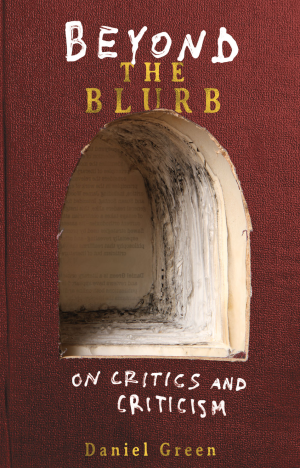
    Anyone looking over my curriculum vitae will see that, while there are a fair number of items listed in the "Publications" section (currently around 140 or so), all but one of them are essays, articles, or reviews, leaving only Beyond the Blurb: On Critics and Criticism (published by Cow Eye Press) as the sole entry declaring itself a book–and even it is a collection of shorter pieces originally published elsewhere, including here on the blog. To anyone asking me if I am a frustrated writer of books who has settled for writing in the shorter forms, I would have to say no. Although shortly after graduate school I did send around a book proposal (not my dissertation) to various university presses, and was offered from one of them a contract of sorts for the exclusive rights, should I actually finish writing the thing, this project never really got off the ground and I eventually just dropped it. Otherwise, I have never actually begun a writing day thinking, "Today I will work on my book."

    Occasionally what seems a pretty good idea for a book comes to me, but quickly enough I'm no longer enamored by the idea and nothing further comes of it. I don't believe this inaction is caused by some kind of a block or a lack of initiative (I'm always writing, just not books). Instead, I think my abilities as a critic–such as they are–are most fruitfully applied to the shorter form, a more circumscribed but also more concentrated space for close reading and succinct analysis. I have always believed that too many full-length works of literary criticism–especially academic books–are padded out with superfluous information and ritualized citations of authorities, although this may just be a reflection of my bias toward text-based explication and analysis rather than theory, biography, or historical critique. Good critics are able to avoid these problems in the best critical books–although many such books are also comprised of previously published essays and articles–but I'm not sure I could be one of those critics, at least while also writing something familiar enough in its form or with a wide enough appeal that it could get published.

    Most of what I want to say about literature (and I do like to think that even in a 1500 word review I am reaching beyond the work at hand to connect it to a literary "issue" or to literary history), I have found I can say in the shorter forms. This does not mean that any such issue can be exhaustively examined or the history fully surveyed in 1500 (or 3,000, or 5,000) words). I have often in fact, addressed the same or similar concerns across multiple reviews or essays, hoping to sound out the topic as fully as possible from different angles. Here the advantages of a book become more apparent. However, I have ventured to collect many of the pieces on common themes in a series of free e-books available through the blog–after concluding no actual publisher would give my collected ruminations on current experimental fiction, for example, even a cursory glimpse–but I'm certain they all gained more readers in their original incarnation as individual items than they have managed to attract through these facsimiles of books. If I'd ventured to write a book about experimental fiction from scratch, it likely would have turned out to be structured much like the e-book, anyway, and surely no publisher would touch this pristine tome, either.

    A propensity for the shorter form was part of my motivation for creating The Reading Experience back in 2004, although I believe this blog actually garnered a reputation for posts a little longer than those on most other blogs, at least back in the antediluvian days of literary blogging. If I had stayed strictly an academic critic, I no doubt would have inaugurated whatever book projects might have been necessary for promotion or to get a better job, or just to stay in the game, but without a game to play, I now envision writing a critical book mostly as something that might happen only when an essay suddenly gets out of hand. Then it would seem a work whose length was an organic development of an idea or analysis that simply required greater amplification.

    Yet an idea for a book has been rattling around in my head for a while, nevertheless, one that would justify its length first by taking the form of an historical narrative–indeed, a history of all of American fiction, from colonial times to the present. But it would also center more narrowly on a progression of works that illustrate the book's argument that American fiction, at least as exemplified by its most accomplished writers, has always been essentially a subversive force, both culturally and formally: American writers have always subjected the country's putative democratic ideals to often harsh scrutiny, and, even more vigorously, have always transgressed against the formal conventions of fiction as those were established by the rise of the European novel (a disposition additionally manifested in the American development of the short story). It would unite my focus on experimental fiction and my longstanding interest in American literary history.

    I would go ahead and write this book if I thought it could be published, but unfortunately.

  • I have sometimes considered writing "personal" criticism–the sort of criticism that embeds discussion of a book or writer in subjective circumstances (the year of reading Whitman!) or connects the work to one's own "life experiences." However, I have always hesitated after reflecting on how little I usually admire such criticism when I do occasionally venture to read it: I really don't care what you were doing the morning you read "Crossing Brooklyn Ferry," and if I wanted to learn about your college years I would seek out your own memoir and not the book you are otherwise supposed to be reviewing.

    (Plus, whenever I have begun a review or critical essay with autobiographical reflections, I quickly rediscover how utterly tedious most of my life has been and that I thus have little to say about it. I can sometimes muster interesting things to say about a book I've read, but not about my life.)

    Arguably the turn to personal or autobiographical criticism became more evident first in academic criticism, as part of the generalized revolt over the past 50 years or so against the academic practices of the previous 50 years (among them "objectivity" and "analysis"), almost all of them ultimately consigned to the dustbin of academic and literary history. (As eventually will be, of course, the practices that came to replace to them–although whether the notion of dispassionate analysis will ever make a comeback is probably more dubious.) The increasing frequency of personal reflection in more general-interest criticism is no doubt less purposeful, the result of some combination of the rise of "creative nonfiction," the domination of reviewing by novelists and poets themselves rather than professional critics, and, of course, the internet.

    It is tempting to say that the latter is the chief culprit, as it is in so many of the other appraisals of the social and cultural upheavals we are currently experiencing, but it seems to me that its primary contribution to this trend has been to provide a great increase in the number of publication sites (including journals meant to replicate print literary magazines and book reviews but also blogs and online reading diaries) for both creative and critical writing, which in turn created the conditions making it possible for more personal essays to be published and creating a need for reputable reviewers. But of course the rise of creative nonfiction, both as a category of publishing and an area of concentration in the creative writing curriculum, was a phenomenon largely independent of the development of the internet and seems explicable mostly as a phenomenon within literary culture, personal expression becoming the predominant aesthetic value. Moreover, the prevalence of creative writers themselves as authors of book reviews surely predates the absorption of book discussion by the internet, and the notion that criticism by practitioners is somehow more authoritative than criticism by those more fully oriented toward, well, criticism, is a failure of judgment by book review editors more than it is a surfeit of qualified critics.

    I would not contend that critical objectivity is always fully possible, nor that literary criticism has no use for subjective impressions. It is possible, however, to describe a literary work under review or analysis with conscientious accuracy, and providing such description has always seemed to me to be one of the pressing–if not the most pressing–obligations of the critic. If evaluation is part of the task in a particular critical piece (a review, presumably), such a judgment cannot credibly be made unless the critic has shown a keen enough comprehension of the relevant features of the text at hand. This sort of attention to the tangible features of the text is what is most often missing from personal/autobiographical criticism, since evaluation still remains, just made more nebulous and subjective than usual. Conventional reviews too often settle for plot summary in place of deeper formal and stylistic explication; personal essays impersonating reviews frequently substitute strings of figurative language expressing the reviewer's readerly sensibility for even cursory plot summary. 

    If readers want some sense of the personality of the reviewer–and I'm not entirely convinced they do: most readers of reviews seem to want a more thought-out kind of reading recommendation–there are ways to convey this without resorting to literal autobiography and personal confession. The reviewer should provide some sense of the standards being used to reach a critical judgment, and this can be done while acknowledging their subjective selectivity–in effect disclosing the reviewer's own aesthetic sensibility as manifested in the assumptions those standards imply. Neither the criteria used nor the application of them to the particulars of the work need to be articulated in a literal, unduly mechanical way–here are the criteria, now watch me apply them–but can be suggested more subtly and indirectly, and executed with a verbal flair and judicious insight that surely draws attention to the critic's individual quality of mind.

    But perhaps the more frequent kind of recourse to the personal or autobiographical in works of ostensible literary criticism is to be found in articles and essays less standardized than reviews, more discursive or exploratory, reflective or ruminative pieces in the form of an "appreciation," reconsideration, or extended critique. Here the temptation to underscore one's response to a writer's work by literally invoking personal reactions and experiences seems greatest, and I do not avow that such a move is wholly illegitimate. If you believe literature can make a difference in people's lives, the evidence from one's own life seems an obvious place to turn. But at some point such exercises become simply personal essays rather than literary criticism, and again my own history of  both writing and reading critical essays tells me it is entirely possible to convey personality and perspective without crossing this line. Close reading or analysis does not require a turgid prose style, nor does it necessarily entail endless quotations and an eye-glazing analytic detachment. The goal should be to be communicate the critic's most concentrated experience of the work, and this ought to motivate his/her most discerning and dynamic writing, not the most pedantic.

    Nonfiction that includes reflections on other writers and writing but is otherwise simply an autobiographical narrative is certainly not encompassed here in my skepticism about autobiographical criticism. I am focusing on literary criticism that incorporates the personal and autobiographical as a strategy for carrying out acts of criticism, often self-reflexively acknowledging the strategy within the piece itself as if to underscore the critical intent. Sometimes the author is simply venturing an experiment with this device, but at other times it seems as though the critic is assuming an implicit assent to such a practice, on the reader's part, but also presumably editors, who may even prefer the personal approach, which is seen in turn as more appealing to readers. The phenomenon seems especially noticeable online (even if its roots lie elsewhere), and to the extent that literary criticism eventually migrates entirely online, traditional exegetical literary criticism may be increasingly shoved aside.

    Since academic criticism has long since abandoned disinterested literary analysis, general-interest publications are really the only venues available (aside from personal blogs) for critics who favor this approach. Without it, we could ask whether literary criticism still exists.

  • Issue three of Long Story Short is now available.

    Includes reviews of:

    Hashtag Good Guy With a Gun (Sagging Meniscus Press), by Jeff Chon

    Bring Me the Head of Quentin Tarantino (Graywolf Press), by Julian Herbert

    Thick Skin (Kernpunkt Press), by N/A Oparah

    Wiki of Infinite Sorrows (Kernpunkt Press), by Matthew Burnside

    Meiselman (Tortoise Books), by Avner Landes

    Free sign-up: https://danielgreen.substack.com/welcome

  • Issue Two

    The second issue of Long Story Short: 500-word Reviews is now available.

    Includes reviews of:

        The Ancestry of Objects (Deep Vellum), by Tatiana Ryckman

       Sea Above, Sun Below (River Boat Books), by George Salis

        The Posthumous Works of Thomas Pilaster (Sublunary Editions), by Eric Chevillard

        Ire Land (a Faery Tale) (Spuyten Duyvil), by Elisabeth Sheffield

        Fucked Up (Expat Press), by Damien Ark

    Sign up.

  • Issue One

    At long last here is the first issue of Long Story Short: 500 Word Reviews. I am still hoping to post issues on a monthly basis, but I did discover this time that, well, first of all you have to read the books before you can review them.

    The books included here are:

    Rituals Performed in the Absence of Ganymede (11:11 Press), by Mike Corrao

    Unidentified Man at Left of Photo (corona\samizdat), by Jeff Bursey

    Ezra SlefThe Next Nobel Laureate in Literature (Tartarus Press), by Andrew Komarnyckyj

    Babel (Splice), by Gabriel Blackwell

    Sign up.